Published: June 2026 | By the Aurorae Lighting design team
Choosing the best chandelier for your American home style isn't about following a single trend or a one-size-fits-all formula. Walk into a lighting showroom or scroll through an online collection, and the advice is always the same: "Add the length and width of your room in feet, and that's your chandelier diameter in inches."
It's a fine starting point. But it completely ignores the thing that actually determines how a chandelier looks and feels in your home — the architecture itself.
An 8-foot-ceiling Ranch and a 20-foot foyer in a new-build Colonial have wildly different needs, even if the rooms happen to be the same square footage. The open floor plan of a Modern Farmhouse demands a different lighting strategy than the compartmentalized rooms of a traditional Colonial. A compact Townhouse living room calls for restraint, while a grand staircase begs for drama.
This guide matches chandelier style, size, and configuration to the five most common American home types — so you can skip the generic formulas and go straight to what actually works for the home you live in.
Jump to your home type
- Ranch House & Single-Story Homes
- Colonial, Georgian & Traditional Homes
- Modern Farmhouse & Open Concept Homes
- Townhouse, Condo & Apartment Living
- New Construction 2-Story & Grand Entryways
- Quick Reference: Home Style → Product → Price
- Three Universal Rules (Any Home Style)
- Frequently Asked Questions
Ranch House & Single-Story Homes
The Challenge: 8-Foot Ceilings Limit Fixture Height
Ranch houses typically have 8-foot ceilings throughout. That's only 96 inches of vertical space, and once you account for a dining table (30 inches) and the recommended 30–34 inches of clearance above it, you're left with roughly 32–36 inches for the fixture itself. A tall, cascading chandelier simply won't fit.
The other challenge is proportional: Ranch homes tend to have moderate-sized rooms (12×14 or 14×16 dining rooms are common), and an oversized fixture will make the ceiling feel even lower.
What Works: Wide, Low-Profile Silhouettes
Think wide rather than tall. Chandeliers with a horizontal spread and compact vertical profile are your best friends in a standard-height ceiling. Look for:
- Fixtures under 15 inches in total height — this leaves comfortable clearance above the dining table without crowding the ceiling.
- Geometric or arc silhouettes that create visual interest through shape rather than vertical drop.
- 5-light configurations — enough presence to anchor a dining room without overwhelming a moderate-sized space.
The exception: Many Ranch homes have a Great Room or living room with a vaulted or cathedral ceiling — sometimes reaching 12–15 feet at the peak. In these spaces, you can absolutely go taller. The key is matching the fixture's proportions to the highest point of the vault, not the walls.
Our Picks for Ranch Homes
The Modern Tiered Half-Ring LED Chandelier (from $959) is purpose-built for this scenario. Its horizontal arc design spreads light across the table without dropping too far from the ceiling. The brushed gold finish adds warmth to Ranch homes' typically neutral palettes.
For a more minimal approach, the Modern Opal Glass Globe Chandelier in the 5-Light Round Canopy configuration (from $699) has a compact 19.6-inch diameter and adjustable cables — you can hang it close to the ceiling for low-clearance rooms or drop it lower in vaulted spaces.
Colonial, Georgian & Traditional Homes
The Challenge: Coordinating Fixtures Across Separate Rooms
Traditional American homes — Colonials, Georgians, Cape Cods, and Federals — share a defining feature: compartmentalized rooms with distinct purposes. The formal dining room is separate from the kitchen. The foyer is a dedicated entry space, not a pass-through. Each room has its own character.
This creates a unique lighting challenge: you need chandeliers in multiple rooms (dining room and foyer at minimum), and they need to coordinate without matching exactly. Identical fixtures in every room feels like a hotel. Completely unrelated fixtures feels chaotic.
Ceiling heights in Colonials are typically 8–9 feet on the first floor, sometimes with a two-story foyer entry. Georgian homes may have 9–10 foot ceilings with crown molding that adds visual height.
What Works: Same Material Family, Different Silhouette
The strategy is same material family, different silhouette:
- Dining room: A crystal or glass chandelier with a structured, formal presence — something your grandmother would approve of but your architect friend would respect.
- Foyer: A vertically oriented piece in a complementary material — crystal spheres, cascading pendants, or a multi-tier design that fills the entry without blocking sightlines into the home.
- Scale tip: The foyer fixture should be slightly larger or more dramatic than the dining room fixture. It sets the tone for the entire home.
Our Picks for Colonial & Traditional Homes
Dining room: The Modern Chrome Crystal LED Chandelier (from $1,085) brings prismatic sparkle to a formal dining table. The K9 crystal accents refract light across the room — a nod to traditional chandelier design with a contemporary linear profile that keeps it from feeling dated.
Foyer: Pair it with the Artisanal Crystal Sphere Chandelier (from $885). The cast crystal sphere with its frosted inner core creates an entirely different visual — sculptural, artistic — while the crystal material connects it to the dining room fixture. Together, they speak the same design language in different voices.
For a Colonial foyer with a ceiling up to 12 feet, the Grand Cascading Prismatic Crystal Chandelier ($993) fills vertical space beautifully with its multi-tier waterfall design.
Modern Farmhouse & Open Concept Homes
The Challenge: One Fixture Can't Light an Open Floor Plan
This is the home type that trips people up the most — and it's common in new-build homes.
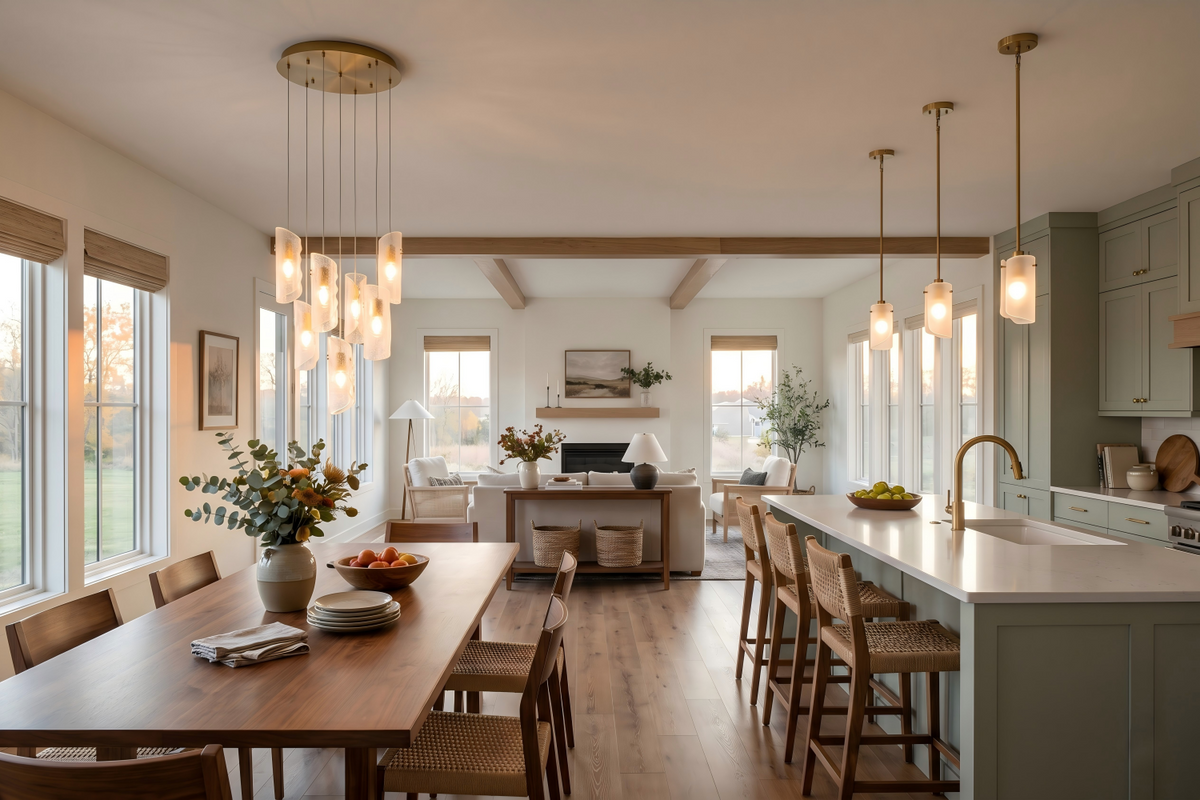
In an open concept floor plan, the kitchen, dining area, and living room share one continuous space. There are no walls to separate them, which means a single chandelier in the center of the room won't work. It'll light one zone and leave the others in shadow. Worse, it'll look lost — one fixture floating in a sea of open space.
Modern Farmhouse styling adds another layer: the aesthetic blends rustic warmth (wood beams, shiplap, natural textures) with clean modern lines. Your lighting needs to bridge both worlds.
What Works: Zoned Lighting With Coordinated Fixtures
The answer is zoned lighting with multiple fixtures — each serving a distinct function within the shared space:
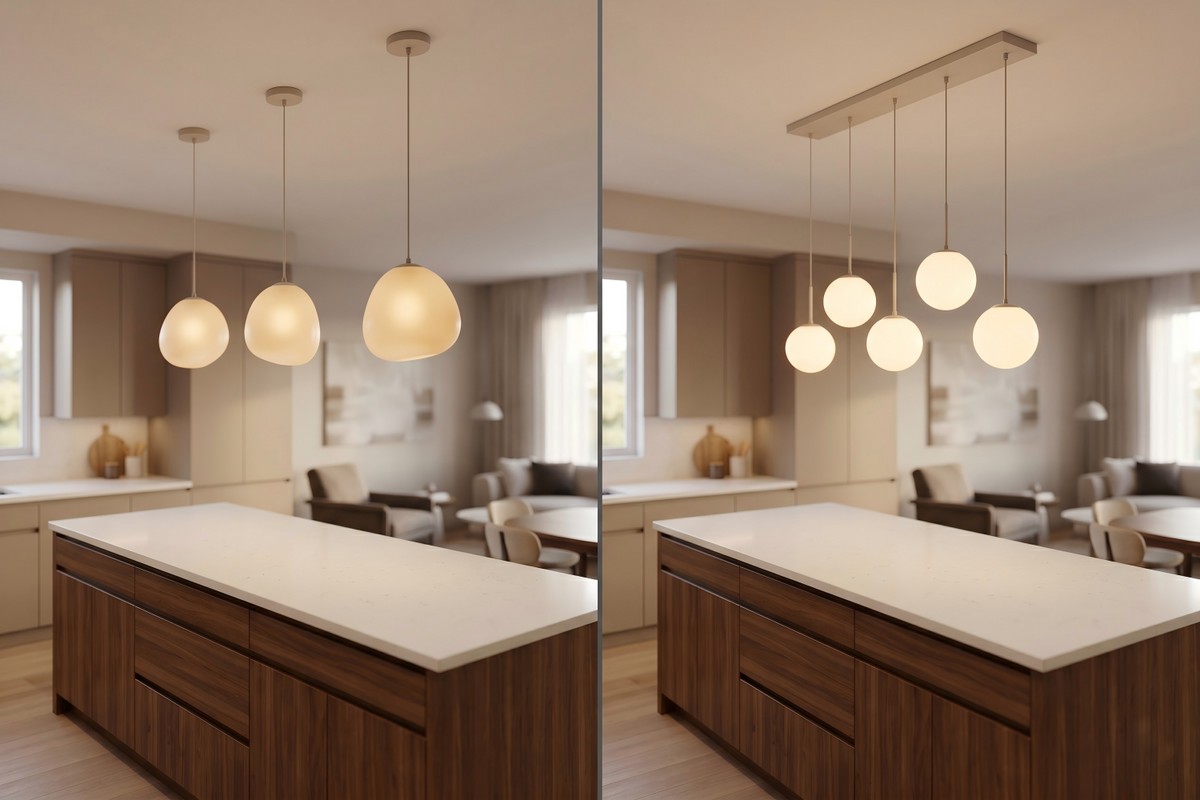
- Kitchen island: 2–3 pendants in a linear arrangement, providing task lighting for food prep and casual meals. Hung 30–34 inches above the countertop.
- Dining table: A statement chandelier that defines the dining zone and signals "this is where we gather." This is your anchor fixture — the one guests notice first.
- Living area: A medium-scale chandelier or pendant that provides ambient light without competing with the dining fixture. Slightly smaller, slightly simpler.
The three fixtures should share a common thread — same metal finish, similar glass treatment, or a consistent design language — without being identical.
Our Picks for Open Concept Homes
Kitchen island: The Organic Hand-Blown Pebbles Glass Pendant (from $219) features irregular, nature-inspired glass forms that channel Farmhouse warmth. The cluster arrangement distributes light evenly across the workspace.
Dining table: The Cascading Textured Glass Chandelier (from $1,299) is the statement piece. Each hand-blown textured glass shade catches and diffuses light differently, creating a warm, layered glow above the table. Its 7-light configuration provides ample illumination for a 6–8 person dining table.
Living area: The Modern Opal Glass Globe Chandelier in 7-Light Round ($899) provides soft, low-glare ambient light. The opal glass connects visually to the textured glass over the dining table — same material family, different expression. Together, they create a cohesive lighting story across the open floor plan.
Budget tip: If you're doing all three zones at once, you're looking at roughly $2,400–$3,500 for a professional-grade lighting package across the entire space. That's less than most people spend on a single sofa — but the visual impact is arguably greater. And remember: scheduling one electrician visit for multiple fixtures is significantly cheaper per fixture than separate trips.
Townhouse, Condo & Apartment Living
The Challenge: Small Spaces Amplify Every Choice
Compact living spaces come with hard constraints: low ceilings (sometimes 7.5–8 feet), small floor plans, and often rental restrictions on major electrical changes. A chandelier that looks stunning in a showroom can overwhelm a 10×12 dining area or make a 7.5-foot ceiling feel oppressive.
There's also a psychological factor: in a small space, every design choice is amplified. A too-large fixture feels like a mistake. A too-small fixture feels like an afterthought. Getting the proportions right matters more here than in any other home type.
What Works: Mini Chandeliers & Light-Reflecting Finishes
- Think "mini chandelier" — 5-light configurations with diameters under 20 inches. These provide real chandelier presence without spatial dominance.
- Round canopy over round or square tables — in tight spaces, a round chandelier centered over a round table creates the most visually balanced composition.
- Light-colored finishes (gold, brass) help the fixture recede slightly, making the ceiling feel higher. Dark fixtures in a low-ceiling room can feel heavy.
- Translucent or opal glass shades diffuse light upward and outward, making the room feel larger than it is. Clear glass or exposed bulbs create harder shadows that shrink the perceived space.
Our Picks for Townhouses & Condos
The Modern Opal Glass Globe Chandelier in 5-Light Round Canopy (from $699) is tailor-made for compact dining spaces. At just 19.6 inches in diameter, it fits comfortably above a 42–48 inch round table. The opal glass reduces glare (crucial when the fixture is close to eye level in a low ceiling), and the gold finish adds warmth without visual weight.
For a kitchen pass-through or breakfast nook, the Sculptural Brushed Brass Cone Pendant (from $1,585) provides a sculptural accent that works beautifully as a single statement in a small space.
Renter's note: If your ceiling has an existing light fixture with a standard junction box, you can swap it for a chandelier and swap it back when you move — no permanent changes needed. Just save the original fixture in a closet. The total job is described in detail in our installation cost guide.
New Construction 2-Story & Homes With Grand Entryways
The Challenge: Filling 16–22 Feet of Vertical Space
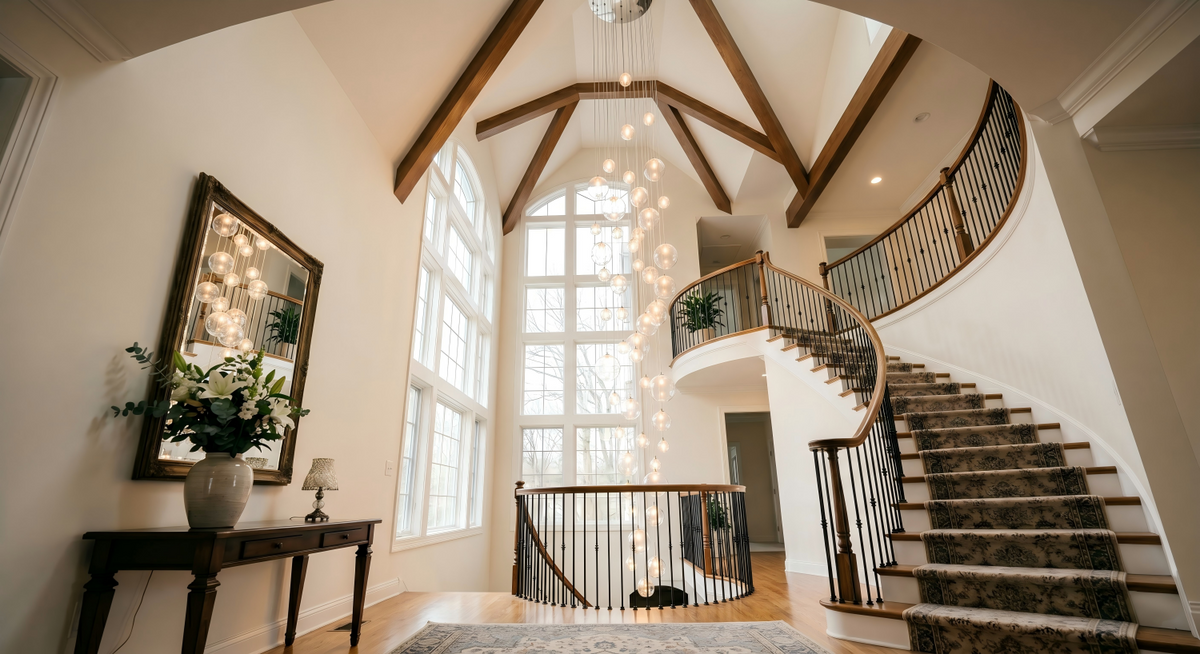
This is the opposite problem from Ranch houses and condos. You have too much vertical space — 16 to 22 feet of open air in the foyer, a sweeping staircase with a double-height stairwell, and a Great Room with soaring ceilings. Standard chandeliers look like lost satellites floating in all that emptiness.
The challenge isn't just size — it's three separate high-impact zones that each need their own lighting:
- The foyer/entryway: Your home's first impression. Guests look up the moment they walk in. This fixture needs to command attention from below while looking beautiful from the second-floor landing above.
- The staircase: The vertical transition zone where a cascading design creates visual continuity between floors.
- The Great Room: Often the largest open space in the home, typically with 15–18 foot ceilings and a wall of windows.
What Works: Vertical Drama & Long Adjustable Cables
- Vertically dramatic fixtures that fill the height of the space. A rule of thumb: the chandelier should occupy roughly 1/3 of the visible vertical space between the floor and the ceiling.
- Extra-long adjustable cables are non-negotiable — most standard chandeliers come with 4–6 feet of cable, which isn't nearly enough for a 16+ foot ceiling. You'll need 10–15 feet of hanging length to bring the fixture down to the right position.
- Multi-element designs (clusters, cascades, multi-tier) read better at a distance than single-shade fixtures. They create visual complexity that holds up when viewed from 20 feet away.
Our Picks for 2-Story Homes — And Our Biggest Advantage
This is where Aurorae Lighting stands out: several of our chandeliers offer long adjustable cables — the Multi-Arm Opal extends beyond 300 inches in its largest configuration, and the Opal Glass Globe (10-light) reaches 177 inches. Many standard chandeliers max out at 6–8 feet, forcing you to special-order extended cables (at extra cost) or hire an electrician to splice additional wire.
With Aurorae, the full length ships in the box. No special orders, no extra cost, no waiting.
Foyer: The Timeless Black Arm Opal Glass Chandelier (from $899) is well suited to 2-story entryways. Its multiple arching arms span outward while the staggered opal globes drop at varying heights, filling both horizontal and vertical space. Available in configurations from 8 to 36 lights — the 36-light version is built for the grandest foyers. Cable length varies by configuration, so confirm the hanging length on the product page for your chosen size.
Staircase: The Dramatic Cascading Acrylic Orb Chandelier (from $1,217) creates a waterfall effect in a stairwell. The staggered orbs catch light from the windows at different heights throughout the day, making it a fixture that genuinely changes character from morning to evening.
Great Room: The Luxe Hand-Blown Textured Glass Orb Chandelier ($1,175) provides a warm, inviting glow that softens the often-cavernous feel of a double-height living space. The textured glass orbs diffuse light beautifully across a large room without the harsh hotspots of exposed-bulb designs.
Installation note: For ceilings above 15 feet, we strongly recommend professional installation. The cost is higher ($500–$1,500) due to scaffolding requirements. Most of our fixtures weigh well under 50 lbs, but larger multi-light configurations can be heavier — check the weight on the product page, since configurations exceeding 50 lbs may require a fan-rated ceiling brace. See our complete installation cost guide for details.
Quick Reference: Home Style → Recommended Products → Price Range
| Home Type | Recommended Fixture(s) | Starting Price | Key Feature |
|---|---|---|---|
| Ranch / Single-Story | Half-Ring Chandelier | $959 | Low-profile arc design for 8ft ceilings |
| Colonial / Traditional | Crystal LED Chandelier + Crystal Sphere | $885–$1,085 | Coordinated crystal pair for dining + foyer |
| Modern Farmhouse / Open Concept | Pebbles Pendant + Textured Glass + Opal Globe | $219–$1,299 | 3-zone lighting for connected spaces |
| Townhouse / Condo / Apartment | Opal Glass 5-Light Round | $699 | 19.6" compact diameter, low-glare opal glass |
| 2-Story / Grand Entryway | Multi-Arm Opal + Acrylic Orbs | $899–$1,217 | Long adjustable cables for 16–20ft+ ceilings (check product page) |
Three Universal Rules (Regardless of Home Style)
Before we wrap up, here are three sizing principles that hold true across every home type:
1. The dining table rule: Your chandelier should be approximately 12 inches narrower than your table on each side. A 42-inch-wide table calls for a 30-inch chandelier. For length, aim for 1/2 to 2/3 of the table's length. Use a round canopy for round and square tables, and a rectangle canopy for long rectangular tables and kitchen islands. For a full walkthrough with table-size charts, see our dining room chandelier size guide and shape-matching guide.
2. The hanging height rule: Bottom of the chandelier should sit 30–34 inches above a dining table surface. In open spaces with no table below (foyer, stairwell, Great Room), maintain at least 7 feet of clearance from the floor to the bottom of the fixture — more if anyone in your household is tall. Our room-by-room hanging height guide covers every scenario, including ceiling-height adjustments and sloped ceilings.
3. The layered lighting rule: A chandelier should never be the only light in a room. Pair it with recessed cans, wall sconces, or table lamps for a complete lighting plan. The chandelier provides ambient warmth and visual drama; other fixtures handle task and accent duties. A dimmer switch transforms your chandelier into a versatile tool — bright for homework, soft for dinner parties.
Frequently Asked Questions
What size chandelier do I need for my dining room?
Add your room's length and width in feet for a rough diameter in inches, then refine using the table: your chandelier should be about 12 inches narrower than your table on each side, and 1/2 to 2/3 of the table's length. A 42-inch-wide table pairs well with a 30-inch chandelier. Ceiling height matters too — keep the fixture under 15 inches tall on a standard 8-foot ceiling.
How high should a chandelier hang above a dining table?
The bottom of the chandelier should sit 30 to 34 inches above the table surface for a standard 8-foot ceiling. For each additional foot of ceiling height above 8 feet, you can raise the fixture roughly 3 inches. Over a kitchen island, use the same 30 to 34 inch clearance above the countertop.
What's the best chandelier for an 8-foot ceiling?
Choose a wide, low-profile fixture under 15 inches in total height so it doesn't crowd the ceiling or hang into sightlines. Horizontal arc and geometric designs work better than tall cascading styles. The Aurorae Half-Ring Chandelier and the 5-Light Round Opal Glass Globe are both built for standard-height ceilings.
What size cable do I need for a 2-story foyer chandelier?
Standard chandeliers ship with 4 to 6 feet of cable, which is not enough for a 16+ foot foyer. You'll typically need 10 to 15 feet of hanging length. Many Aurorae fixtures include longer cables — the Multi-Arm Opal extends beyond 300 inches in its largest configuration, and the 10-light Opal Glass Globe reaches 177 inches. Always confirm the cable length on the product page for your specific configuration, since smaller sizes of the same fixture may have shorter cables.
How do I light an open concept floor plan?
Use zoned lighting with separate fixtures for each function: 2 to 3 linear pendants over the kitchen island, a statement chandelier over the dining table, and a medium-scale fixture in the living area. Tie them together with a shared metal finish, glass treatment, or design language so they coordinate without matching exactly.
Can I install a chandelier myself, or do I need an electrician?
If you're replacing an existing fixture on a standard junction box at a reachable height, many homeowners handle it as a DIY swap. Hire an electrician for high ceilings (over 12 feet), new wiring, heavier configurations that may need a fan-rated brace, or any situation where you're not fully confident. For ceilings above 15 feet, professional installation with scaffolding is strongly recommended. See our installation cost guide for a full breakdown by scenario.
Need Help Choosing?
Every home is different, and sometimes the generic advice doesn't quite apply to your specific floor plan, ceiling height, or design vision. That's what we're here for.
Email us at info@auroraelighting.com with a photo of your space (even a phone snapshot helps), your ceiling height, and any fixtures you're considering. Our lighting consultants will send you a personalized recommendation — no purchase required, no sales pressure.
For interior designers and trade professionals, our Trade Program offers trade pricing and written project quotes for multi-room projects.
Every Aurorae fixture ships with dimmable LEDs in the color temperature shown on the product page (CRI >90). If your ceiling is sloped, we provide an adapter at no extra cost once the angle is confirmed. UL Listed for US & Canada, CE certified for European markets. Backed by our 4-year warranty.
About the Author
The Aurorae Lighting design team works with homeowners, interior designers, and builders across the United States to match fixtures to real architecture — from 8-foot Ranch ceilings to 22-foot new-construction foyers. Our recommendations draw on hundreds of fulfilled orders and direct customer feedback on what actually fits, installs, and looks right in American homes. Have a tricky space? Email us a photo and we'll help you size it.
Related Guides
- How High to Hang a Chandelier: The Complete Room-by-Room Height Guide
- How to Choose the Right Size Chandelier for Your Dining Room [2026 Guide]
- Chandelier Shape Guide: How to Match Your Chandelier to Your Dining Table
- How Much Does It Cost to Install a Chandelier? Complete 2026 Guide
- 2026 Chandelier Trends: 5 Styles That Are Defining Modern Interiors