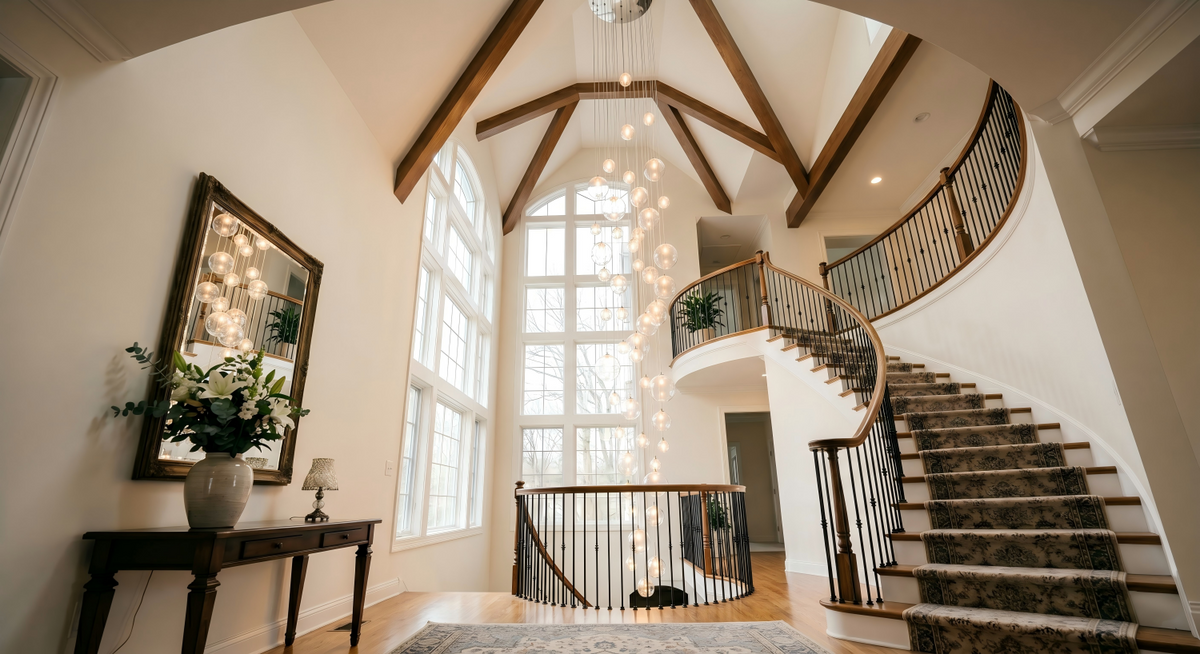
You walk into a home with a 2-story foyer. Your eyes go up — instinctively, immediately, every time. That vertical space is the first thing visitors experience. It's the backdrop for every arrival, every holiday greeting, every "welcome home." And right now, it probably has either a builder-grade flush mount clinging to the ceiling 18 feet above, or nothing at all.
That empty vertical space is the single biggest design opportunity in your home. A well-chosen chandelier doesn't just fill it — it commands it. It transforms a tall, empty column of air into a focal point that sets the tone for the entire house.
But choosing a chandelier for a 2-story foyer is harder than choosing one for a dining room. The proportions are different. The cable requirements are different. The visual impact of getting it wrong is amplified by the sheer scale. This guide walks you through every decision — size, height, style, and cable length — so you get it right the first time.
In This Guide
- Why High Ceilings Demand a Different Approach
- Sizing Your Chandelier for High Ceilings
- The Cable Length Problem (and Why Many Chandeliers Can't Reach)
- Hanging Height: Where to Position It
- Best Chandelier Styles for High Ceilings
- Style Matching: Your Home's Architecture Dictates the Direction
- Foyer Chandeliers and Resale Appeal
- Installation Considerations for High Ceilings
- Common Mistakes in High-Ceiling Spaces
- Your High-Ceiling Selection Checklist
Why High Ceilings Demand a Different Approach
In a standard 8-foot ceiling room, a chandelier relates primarily to the table or floor below it. The ceiling is close — maybe 3 feet above the fixture top. The fixture lives in the "human zone" where you eat, talk, and make eye contact.
In a 2-story foyer, the fixture lives in a vertical gallery. It's viewed from below (standing in the entryway), from across (the second-floor landing or hallway), and sometimes from above (looking down over a railing). It needs to look correct from three different perspectives simultaneously — and that changes everything about how you select and position it.
The three rules unique to high-ceiling spaces
Rule 1: Vertical proportion matters more than diameter. In a dining room, you care about the fixture's width relative to the table. In a 2-story foyer, you care about the fixture's height relative to the vertical space. A fixture that's 24 inches wide and 12 inches tall will look correct over a dining table but will disappear in a 16-foot foyer — it doesn't fill enough of the vertical column. For high ceilings, you need fixtures with significant vertical dimension: cascading designs, multi-tier chandeliers, or cluster pendants with staggered drop heights.
Rule 2: The fixture is viewed from distance. From the front door of a foyer, you might be 8–15 feet from the chandelier. Details that read beautifully up close — delicate etching, subtle texture, small crystal pendants — become invisible at that distance. High-ceiling fixtures need to make their statement through form and light, not fine detail. Bold silhouettes, generous glass surfaces, and visible light sources carry better across open vertical spaces.
Rule 3: Installation access is expensive. Changing a chandelier in a 2-story foyer typically requires scaffolding or a specialized 16–20 foot ladder. An electrician may charge $500–$1,000+ for the installation (versus $150–$400 for a standard ceiling — see our Installation Cost Guide). Getting the selection right the first time matters more here than anywhere else in the house.
Sizing Your Chandelier for High Ceilings
The diameter formula
The standard room formula still applies: room length + width (feet) = diameter (inches). A 10 × 12 foot foyer calls for about a 22-inch fixture. A 14 × 14 foyer calls for 28 inches.
But for foyers specifically, err toward the larger end of the range. A chandelier that's at the upper limit of the recommended diameter looks intentionally grand in a foyer — it's the architectural equivalent of a period at the end of a sentence. A fixture that's at the lower limit looks tentative, like it wasn't sure it belonged there.
The height formula — the one most people forget
For high-ceiling spaces, the fixture's body height (the vertical dimension of the chandelier itself, not including the cable) should be proportional to the ceiling height:
Fixture body height = 2.5 to 3 inches per foot of ceiling height.
| Ceiling Height | Recommended Fixture Body Height | Cable Drop Needed |
|---|---|---|
| 10 ft | 25–30" | ~36" |
| 12 ft | 30–36" | ~48–60" |
| 14 ft | 35–42" | ~72–84" |
| 16 ft | 40–48" | ~96–108" |
| 18 ft | 45–54" | ~108–120" |
| 20 ft | 50–60" | ~120–144" |
A fixture body height of 50 inches is over 4 feet tall — that's a significant sculptural presence. This is why cascading cluster pendants and multi-tier chandeliers are so popular in 2-story foyers: they naturally have the vertical dimension needed to fill the space, while compact single-tier designs look lost.
The Cable Length Problem (and Why Many Chandeliers Can't Reach)
This is the detail that catches most buyers off guard. You find the perfect fixture, order it, and the electrician arrives — only to discover the cable isn't long enough to lower the chandelier to the correct hanging height.
Here's the math. For a 16-foot ceiling with the fixture bottom at 8 feet above the floor:
- Ceiling height: 192 inches (16 ft)
- Fixture bottom target: 96 inches above floor (8 ft)
- Fixture body height: ~42 inches
- Cable needed: 192 − 96 − 42 = 54 inches minimum
For a 20-foot ceiling with the same 8-foot bottom clearance and a 48-inch fixture:
- Cable needed: 240 − 96 − 48 = 96 inches minimum
Many chandeliers include 48–72 inches of cable or chain. That works for standard ceilings but falls short for anything above 12 feet. The fix is usually an "extension kit" that costs $30–$80 and requires additional installation time — if the brand even offers one.
Many of Aurorae's cluster pendants and chandeliers are designed with long adjustable cables specifically for high ceilings — several models reach well beyond 12 feet of total drop. The Glass Pebbles Cluster and Crystal Sphere reach 177 inches in their largest configurations, and the Modern Crystal Ball reaches 196 inches. Cable length varies by model and configuration, so the right approach is simple: pick the fixture you love, check its maximum drop on the product page, and confirm it covers your ceiling height. For the tallest foyers, our team can advise on the ideal configuration — and custom cable lengths are available on request. This is one of our most important design priorities, driven specifically by feedback from homeowners with 2-story foyers and stairwells.
Hanging Height: Where to Position It
The complete hanging height guide covers every room, but here's the specific guidance for high-ceiling spaces:
Foyer without staircase (10–14 ft ceiling)
Bottom of fixture: 7.5–8 feet above the floor. This keeps the chandelier at a comfortable height — low enough to create visual impact when you walk in, high enough that no one feels it's in their way. The gap between the fixture top and the ceiling can be large (4–6 feet of cable visible), which is normal and expected in taller spaces. That visible cable is part of the design — it shows the viewer the full height of the space.
Foyer with staircase (16–20+ ft ceiling)
Center of the fixture body should align with the second-floor railing or landing level. This positions the fixture where it can be appreciated from both the ground floor (looking up) and the upper floor (looking across). The bottom of the fixture will sit approximately 8–10 feet above the ground floor — well above head height.
If your staircase wraps around the foyer (L-shaped or U-shaped stairs), the chandelier occupies the open center of the stairwell. In this configuration, the fixture is viewed from every angle as you ascend — so choose a design that looks good from 360 degrees, not just from the front door.
The critical measurement: bottom clearance
Regardless of ceiling height, the bottom of the chandelier must never hang lower than 7 feet above the floor in any area where people walk. In a foyer, this means 7 feet at the entry threshold. If the foyer has a step down or a sunken area, measure from the lowest floor point.
Best Chandelier Styles for High Ceilings
Not every chandelier style works in a tall space. Here's what performs best and why.
Cascading cluster pendants — staggered drops
Multiple glass elements suspended at staggered heights from a single canopy. This format suits high ceilings: the staggered drops naturally fill vertical space, the cluster of light sources creates visual density from every viewing angle, and the configuration can be adjusted by lengthening or shortening individual cables.
Best for: 2-story foyers, open stairwells, great rooms.
- Black Arm Opal Glass Chandelier ($899+) — Our top pick for foyers and staircases. Articulated black arms hold frosted opal glass shades at staggered heights, creating a sculptural cascade that reads beautifully from below, across, and above. Its arms give it true 360-degree presence — essential for an open stairwell — and the design scales from an 8-light entry statement up to grand multi-canopy configurations for the tallest spaces. The opal glass diffuses light softly and warmly at 2700K, with minimal glare or hotspots from any viewing angle.
- Cascading Acrylic Orb Chandelier ($1,217+) — Luminous orbs cascading in a vertical column, with up to 118 inches of adjustable drop. The translucent acrylic creates a "floating moons" effect that's particularly dramatic when viewed from the second floor looking down.
- Slim Glass Cascading Pendant ($386+) — Sleek, slim glass tubes at staggered heights for a more minimal stairwell statement, reaching up to 138 inches of drop. A budget-friendly option for high ceilings without sacrificing vertical presence.
- Cream Glass Globe Cluster ($2,399+) — Warm cream-toned glass globes in a soft, organic arrangement reaching up to 157 inches. The opaque globes glow from within, creating a warmer, more residential feeling than transparent glass options — ideal for a welcoming entry.
Multi-tier chandeliers — classic grandeur
Multiple rings or arms arranged at different vertical levels on a single frame. Multi-tier chandeliers have the architectural gravity to anchor a tall foyer — their layered silhouette reads clearly from long distances and their multiple tiers of light fill the space evenly.
- Grand Cascading Crystal Chandelier ($993) — Multi-tier prismatic crystal that creates a continuous sparkle from top to bottom. Prismatic crystal refracts light throughout the foyer, casting dancing patterns on the walls that change throughout the day. With a total height of about 63 inches, it's ideally suited to 10–12 foot foyers, where its full prismatic cascade sits at the perfect viewing level.
- K9 Crystal Spiral Chandelier ($1,486+) — A spiral form that follows the natural geometry of a curved staircase, with a brass star-cascade frame. The spiral creates a sense of movement and direction — your eye follows it upward, experiencing the full height of the space — and it offers up to 84 inches of adjustable drop.
Statement spheres — bold and minimal
A single large form that makes its impact through scale and luminosity rather than complexity. This approach works best in modern and contemporary interiors where clean lines dominate.
- Crystal Sphere Chandelier ($885+) — A luminous sphere with an internal frosted core that glows from within, reaching up to 177 inches of drop in its largest configuration. The sphere form creates an immediate focal point that reads clearly from any distance and any angle — no "front" or "back," just a perfect orb of light. Particularly effective in minimalist foyers where a busy multi-arm design would conflict with the architectural simplicity.
- Modern Crystal Ball Pendant ($852+) — A cluster of crystal spheres with a teardrop-arc glow and configurable height, reaching up to 196 inches in its largest configuration. The faceted surface catches and scatters light in every direction, and the staggered cluster of spheres suits foyers where a single bold gesture is sufficient.
Style Matching: Your Home's Architecture Dictates the Direction
The right chandelier for a 2-story foyer depends not just on size and height, but on the architectural character of your home. Here's a quick matching guide (for the complete version, see our Chandelier Guide by Home Style):
| Home Style | Foyer Character | Best Chandelier Direction | Our Pick |
|---|---|---|---|
| Colonial / Traditional | Formal, symmetrical, wood staircase | Cascading crystal — classic elegance that matches formal moldings and banisters | Modern Chrome Crystal LED ($1,085+) |
| Contemporary / Modern | Clean lines, open railing, minimal details | Statement sphere or acrylic cluster — organic forms that complement without competing | Cascading Acrylic Orb ($1,217+) |
| Transitional | Mix of traditional and modern elements | Opal glass cluster — warm and approachable, bridges both worlds | Black Arm Opal Glass ($899+) |
| Farmhouse / Rustic | Exposed beams, natural wood, warm tones | Cream or warm glass cluster — organic materials that echo the natural warmth | Cream Glass Globe Cluster ($2,399+) |
| Mediterranean / Luxury | Iron railing, stone or tile, arched elements | Crystal spiral — ornate texture that matches the architectural richness | K9 Crystal Spiral ($1,486+) |
The Listing Photo Factor: Foyer Chandeliers and Resale Appeal
If you're considering a foyer chandelier partly for resale value, here's a fact worth knowing: the foyer is one of the most-photographed rooms in real estate listings. The front door photo — showing the entryway with the staircase behind it — is typically the second or third image in the listing gallery, right after the exterior shot.
A cascading chandelier in that photo transforms the image from "nice entryway" to "wow." It signals quality, design attention, and the kind of home that's been invested in. Real estate agents often rank foyer chandelier upgrades as one of the highest-impact, lowest-cost improvements before listing — and 2-story foyers amplify this effect because the vertical drama is so visually striking in photographs.
Installation Considerations for High Ceilings
Scaffolding vs extra-tall ladder
For ceilings up to 16 feet, a qualified electrician with a 16-foot A-frame ladder can typically handle the installation. For 18+ foot ceilings, scaffolding may be required — adding $200–$400 to the installation cost. Always discuss ceiling height with your electrician before the appointment so they arrive with the right equipment.
Weight and junction box
Standard ceiling junction boxes support up to 50 lbs. Most Aurorae fixtures in foyer-appropriate sizes fall well under this — the 8-light Black Arm Opal Glass is about 16 lbs, the 13-light Acrylic Orb about 18 lbs, and the Grand Cascading Crystal about 18 lbs — so they install on a standard box with no added reinforcement. Larger configurations (typically 24+ lights) and heavier crystal designs can exceed 50 lbs; these require a fan-rated ceiling brace for safe installation, which adds roughly $20–$40 in parts. Always check the exact weight of your chosen configuration on its product page and confirm your junction box is rated for it before installation day.
Future access for bulb changes
One detail worth considering: how will you change a burned-out bulb in a fixture that's 12 feet off the floor? The good news is that Aurorae LED bulbs are rated for tens of thousands of hours — many years of normal use — so replacements are rare. The bulbs that ship with the fixture are very likely the only bulbs you'll install for a long time. Bulb type varies by model (replaceable G4, G9, E14, or E26 LEDs, or integrated LEDs, depending on the design), and the replaceable types are standard, widely available bulbs that swap out easily with a ladder or a long-reach bulb changer tool ($15–$25 at any hardware store). Check your fixture's product page for its specific bulb type.
The motorized lift option
For homeowners who want the ultimate convenience, a motorized chandelier lift (sometimes called an aladdin light lift) can be installed above the ceiling during construction or renovation. These systems lower the chandelier to waist height for cleaning and bulb changes, then raise it back to its hanging position with the press of a button. They run $300–$800 for the lift mechanism plus installation. It's a luxury upgrade, but for ceilings above 16 feet, it can pay for itself over the fixture's lifetime by eliminating the cost of professional cleaning visits or electrician calls for maintenance.
Common Mistakes in High-Ceiling Spaces
Mistake 1: Choosing a fixture designed for 8-foot ceilings
A compact, wide chandelier that looks beautiful over a dining table will look like a postage stamp in a 16-foot foyer. High-ceiling fixtures need vertical presence — height, not just width. If the fixture body is less than 30 inches tall, it almost certainly won't have enough visual mass for a 2-story space.
Mistake 2: Hanging it too high
The instinct is to hang the chandelier high in a tall foyer — "closer to the ceiling where it belongs." But a chandelier pressed against a 16-foot ceiling looks like a flush mount from below — tiny, disconnected, wasting the vertical space it was meant to fill. Drop it down. The visible cable between the canopy and the fixture is a feature, not a flaw. It shows the viewer the full scale of the space and creates visual tension between the ceiling above and the floor below.
Mistake 3: Ignoring the second-floor view
If your 2-story foyer is open to an upper hallway or landing, people will see the chandelier from above. A fixture that looks great from below but has an ugly top (exposed wiring, a bare canopy plate, a plain metal frame) will disappoint from the upstairs perspective. Choose fixtures with visual interest from all angles — cluster pendants and spheres perform well here because they have no obvious "top" or "bottom."
Mistake 4: Forgetting to dim
A large chandelier at full brightness in a foyer can feel overwhelming — especially at night when the space is enclosed and there's no competing daylight. Install a dimmer switch (Lutron Diva at $25–$40, or Lutron Caséta at ~$60 for smart home integration) and run the fixture at 70–80% for daily use. At this level, the chandelier is warm and welcoming without being aggressive. Reserve 100% for daytime or when you need maximum light for tasks.
Your High-Ceiling Selection Checklist
- Measure your ceiling height. Exact number, in feet and inches.
- Calculate fixture body height needed: ceiling height (ft) × 2.5 to 3 = body height (inches).
- Calculate cable drop needed: ceiling height − desired bottom clearance (7–8 ft from floor) − fixture body height = cable drop. Confirm your chosen fixture and configuration offers enough adjustable cable on its product page.
- Choose a style with vertical presence: cascading cluster, multi-tier, or statement sphere.
- Confirm the weight of your configuration and check your junction box rating — add a fan-rated brace if the fixture exceeds 50 lbs.
- Plan installation access: discuss ceiling height with electrician before scheduling.
- Install a dimmer switch at the same time — ask the electrician to swap the wall switch during installation.
Ready to fill your vertical space? Browse our Cluster Pendant Collection and Crystal Chandelier Collection, or explore fixtures organized by Entry & Foyer Lighting and Staircase Lighting. Every fixture is dimmable with warm white LEDs (2700K on most models, 3000K on select crystal and glass designs; 6000K cool white also available on select designs) at CRI >90, UL Listed for US & Canada, CE certified for European markets, and a sloped-ceiling adapter is provided at no extra cost once an angled ceiling is confirmed. Need help choosing? Email us a photo of your foyer — include the ceiling height and staircase layout — and we'll recommend specific fixtures for your space.
Frequently Asked Questions
What size chandelier do I need for a 2-story foyer?
Start with the standard formula — room length + width in feet equals the diameter in inches — but for a foyer, err toward the larger end of the range, since a fixture that's too small looks lost in the vertical space. Just as important is the fixture's body height: aim for about 2.5 to 3 inches of fixture height per foot of ceiling height. A 16-foot foyer, for example, calls for a fixture body around 40–48 inches tall, which is why cascading clusters and multi-tier designs work so well in tall entryways.
How long does the cable need to be for a high foyer?
Use this formula: ceiling height minus your desired bottom clearance (usually 7.5–8 feet above the floor) minus the fixture's body height equals the cable drop you need. A 16-foot ceiling with the fixture bottom at 8 feet and a 42-inch fixture body needs about 54 inches of cable. Many chandeliers only include 48–72 inches, which falls short for tall spaces. Many Aurorae fixtures are built with long adjustable cables for exactly this reason — several models reach well beyond 12 feet of drop — but the maximum varies by model, so check the product page to confirm it covers your ceiling.
How high should a foyer chandelier hang?
For a foyer without a staircase (10–14 foot ceiling), position the bottom of the fixture 7.5–8 feet above the floor. For a foyer with a staircase (16–20+ feet), center the fixture body at the level of the second-floor railing or landing, so it can be appreciated from both the ground floor and upstairs. In every case, the bottom of the chandelier must stay at least 7 feet above the floor anywhere people walk.
Will a heavy foyer chandelier need extra ceiling support?
It depends on the configuration. Standard ceiling junction boxes support up to 50 lbs, and most Aurorae fixtures in foyer-appropriate sizes fall well under that — the 8-light Black Arm Opal Glass is about 16 lbs, for instance. Larger configurations (typically 24+ lights) and heavier crystal designs can exceed 50 lbs and require a fan-rated ceiling brace for safe installation, which adds roughly $20–$40 in parts. Always check the exact weight of your chosen configuration on its product page and confirm your junction box is rated for it.
What's the best chandelier style for a high foyer?
Cascading cluster pendants are usually the best choice — their staggered drops naturally fill vertical space and look good from every angle, which matters in an open stairwell. Our top pick is the Black Arm Opal Glass Chandelier, whose articulated arms give it true 360-degree presence. Multi-tier crystal chandeliers offer classic grandeur, and a single statement sphere works beautifully in minimalist spaces. The right direction depends on your home's architecture — formal and traditional homes suit crystal, while modern and contemporary spaces suit glass clusters or spheres.
Related Guides
- How High to Hang a Chandelier: Room-by-Room Height Guide
- Chandelier Size Guide for Dining Rooms
- Best Chandelier for Every American Home Style
- Chandelier Installation Cost Guide: DIY vs Electrician
- Chandelier Color Temperature Guide: 2700K vs 3000K vs 4000K
- 2026 Chandelier Trends: 5 Styles Defining Modern Interiors