
Last updated: March 2026 | By the Aurorae Lighting design team
The chandelier trends for 2026 are not about a single "hot" style replacing last year's. They represent a fundamental shift in what homeowners, designers, and architects expect from the fixture hanging above a dining table, in a foyer, or over a kitchen island: not just illumination, not just decoration, but something that feels personal, crafted, and alive.
We track these shifts from two directions. From the industry side, we follow High Point Market (the largest furnishings trade show in the world), Houzz trend reports, and design publication coverage. From the retail side, we see what our own customers are actually buying, configuring, and asking about across 25 chandelier and pendant designs shipping to all 50 US states. When both signals point the same direction, that is a real trend — not a magazine prediction.
Five directions have emerged clearly for 2026. This guide breaks down each one — what it looks like, why it resonates, how to bring it into your home, and which fixtures deliver it at specific price points. Whether you are renovating a dining room, furnishing a new build, or simply upgrading a dated fixture, at least two of these trends will speak directly to your space.
In This Guide
- Trend 1: Hand-Blown and Textured Glass
- Trend 2: Organic and Botanical Forms
- Trend 3: Warm Metals and Mixed Finishes
- Trend 4: Modular and Configurable Designs
- Trend 5: Human-Centric Lighting and Smart Dimming
- What Is Fading in 2026
- Trend Cheat Sheet
- How to Choose the Right Trend for Your Room
Trend 1: Hand-Blown and Textured Glass — Imperfection Is the New Luxury
This is the single biggest material story in lighting right now, and it has been building for three years. At the fall 2025 High Point Market, glass appeared in nearly every showroom, manipulated in more ways than ever: seeded, bubbled, striated, sandblasted, stretched, stained, smoked, clouded, and fluted. The newest frontier is glass that evokes the movement of water — designs that create the illusion of raindrops, melting ice, and flowing water.
Why Artisan Glass Is Defining 2026 Chandelier Design
In a world of perfectly uniform, machine-stamped products, hand-blown glass offers something machines literally cannot produce: uniqueness. Each shade has subtle variations in thickness, texture, and translucency — the fingerprints of the artisan who shaped it. Two shades from the same batch are siblings, not clones. When you install a hand-blown glass chandelier, no one else in the world has exactly the same fixture.
This aligns with a broader consumer shift that design publications have been tracking: interior design increasingly turns toward local manufacturers, traditional techniques, and hand craftsmanship. Light becomes a bearer of story — not an anonymous product.
Hand-blown glass also performs beautifully as a lighting material. Frosted and textured glass diffuses light naturally — scattering it in soft, low-glare patterns that fill a room with ambient warmth rather than harsh directional beams. Under warm white LEDs, textured glass produces the kind of golden, layered glow that transforms a dining room into the best version of itself.
Textured Glass Chandeliers to Consider
- Luminous Waves Chandelier ($997+) — Our most literal interpretation of this trend. Each shade is hand-blown into a flowing, wave-like form from frosted glass. The organic shapes catch and scatter light differently depending on the angle, creating gentle movement on walls and ceilings even when the fixture is perfectly still.
- Cascading Textured Glass Chandelier ($1,299+) — Multiple textured glass shades at staggered heights create a cascading waterfall effect. Every shade has a unique surface pattern from the hand-blowing process — no two installations look identical.
- Textured Glass Orb Chandelier in Gold ($1,175) — Substantial hand-blown orbs with visible texture on a gold frame. The combination of organic glass and warm metal hits two 2026 trends simultaneously.
- Ice Cube Glass Pendant ($892+) — Internal bubble texture that evokes frozen water — directly aligned with the "watery glass" direction seen at High Point Market.
Trend 2: Organic and Botanical Forms — Nature as the Design Brief
Drawing inspiration from the natural world has been a constant in furniture and lighting design for years. But 2026 takes it further. This season, the emphasis shifted to the portrayal of living things in the act of growing, blossoming, and emerging — not just static representations of leaves or flowers, but forms that feel like they are mid-transformation.
At the industry level, biophilic lighting design — bringing nature indoors — is defining sophisticated living for 2026. The trend spans from literal botanical forms (petals, branches, cocoons) to abstracted organic shapes (pebbles, droplets, flowing curves) that simply feel natural without directly copying any specific organism.
Why Biophilic Lighting Resonates With Modern Homeowners
Post-pandemic homeowners have a fundamentally different relationship with their indoor spaces. We spend more time inside than any previous generation. Organic forms in lighting create a subconscious connection to the outdoors — the curves, asymmetries, and soft shapes that our visual cortex associates with the natural world. Rooms with organic lighting feel calmer and more restorative than rooms dominated by rigid geometric fixtures.
There is also a practical element: organic shapes are inherently forgiving. A perfectly geometric fixture must be hung perfectly level and perfectly centered or the asymmetry is glaringly obvious. An organic form — petals, pebbles, flowing waves — looks intentional even if it is slightly off-center. It is designed for real homes, not showrooms.
Botanical and Nature-Inspired Chandeliers to Consider
- Hand-Sculpted Ceramic Bloom Chandelier ($2,522+) — The statement piece of this trend. Dozens of individually shaped ceramic petals, each formed and finished by hand, cluster together into a form that looks like a flower in the act of opening. It is sculpture that happens to illuminate a room. This is the fixture that guests walk into a room and immediately ask about.
- Pebbles Pendant Light ($219+) — Hand-blown glass shapes inspired by river-smoothed stones. Organic, tactile, unpretentious. At $219, this is the most accessible entry point into the organic trend — perfect for kitchen islands where multiple pendants create a cluster of natural forms.
- Glass Pebbles Cluster Pendant ($4,032+) — The grand-scale version: a constellation of glass pebble shapes at staggered heights, designed for staircases, 2-story foyers, and dramatic living rooms where you want nature-inspired forms to fill vertical space.
Trend 3: Warm Metals and Mixed Finishes — The End of Cool Chrome
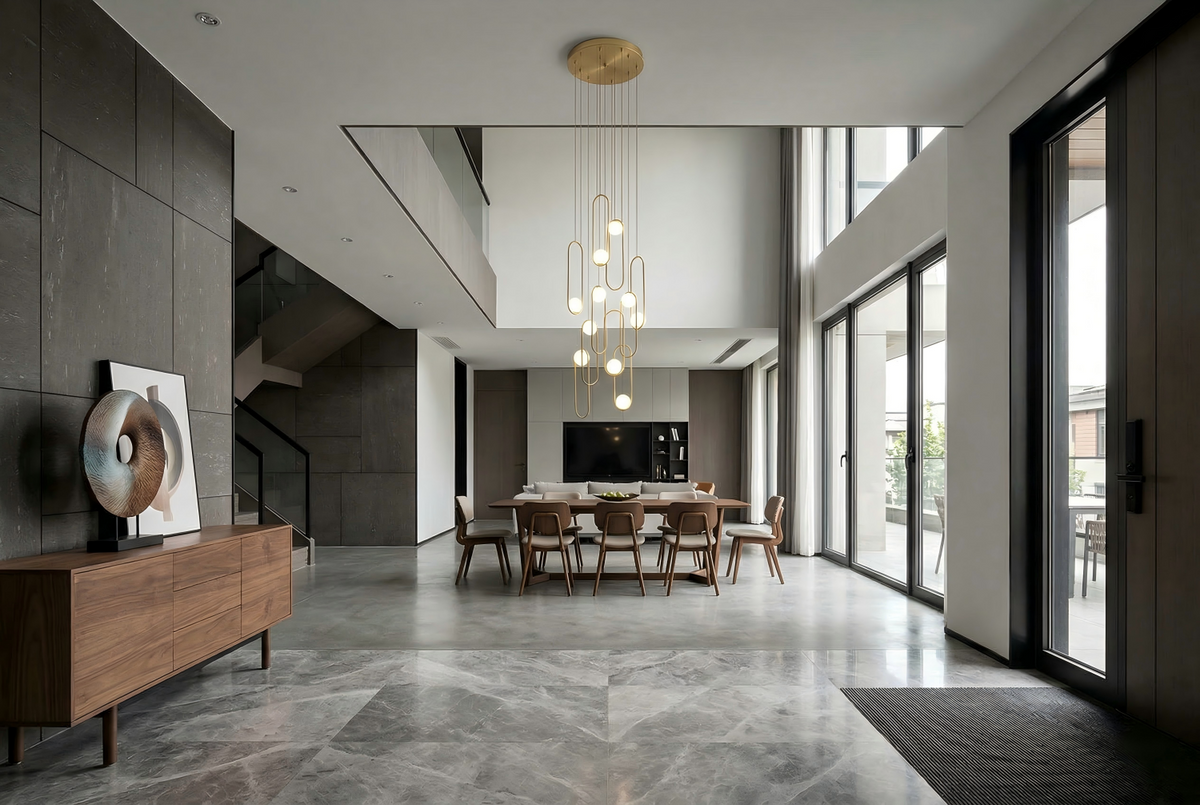
Warm metals such as brushed brass, soft gold, and champagne tones dominate lighting designs in 2026. Paired with gentle, ambient illumination, these finishes create a rich and inviting atmosphere that feels elevated without trying too hard.
The shift away from cool, polished metals (chrome, polished nickel) has been gradual but decisive. Chrome fixtures have not disappeared — they still have a place in certain contemporary and transitional interiors — but the energy of 2026 is firmly warm. Brushed gold, aged brass, matte black, and especially mixed-metal combinations are where the excitement is.
Why Warm Metal Finishes Are Replacing Chrome in 2026
Warm metals create visual warmth before the bulbs are even turned on. A brushed gold frame catches ambient light from windows and reflects it in a soft, golden tone — pre-warming the room's color palette. When the LEDs come on, the warm metal amplifies the warm white glow rather than fighting it.
The mixed-finish trend takes this further. Standout designs in 2026 mix contrasting finishes, such as matte black paired with glass crystals, or frosted glass layered above polished chrome. Designers describe this as "intentional contrast" — the visual tension between a matte surface and a glowing one, or between dark metal and translucent glass, creates depth and sophistication that single-finish fixtures cannot achieve.
For homeowners, mixed-metal chandeliers solve a practical problem too: they coordinate with existing hardware in your home without needing to be an exact match. A fixture with both gold and black elements bridges a kitchen with brass cabinet pulls and a dining room with matte black door handles.
Warm Metal and Mixed-Finish Chandeliers to Consider
- Modern Tiered Gold Half-Ring LED Chandelier ($959+) — Pure warm-metal statement. The tiered arc form in brushed gold is the epitome of 2026's warm metallic direction — sculptural, warm, and unmistakably modern.
- Opal Glass Globe Chandelier in Gold ($699+) — The gold finish frame paired with milky white opal glass creates exactly the warm-metal-meets-diffused-glass combination that defines the 2026 palette. Also available in matte black for the other side of the mixed-finish trend.
- Cascade Cone Pendant in Brushed Brass ($1,585+) — Sculptural brass cones that double as a warm-metal design statement. The metal cone form reads differently from glass-and-metal combinations — bolder, more architectural, more assertive.
- Chrome Crystal LED Chandelier ($1,085+) — For those who love cool metals: chrome paired with K9 crystal is a classic combination that remains relevant in formal and traditional spaces. The crystal adds warmth through light refraction that softens the chrome's cooler tone.
Trend 4: Modular and Configurable Designs — Your Chandelier, Your Way
Personalization has been a macro trend in interiors for years, but 2026 is the year it truly arrives in chandelier design. From customizable finishes and interchangeable components to multi-configuration mounting options, the idea of buying a single fixed design is giving way to systems that adapt to your space.
Adjustable and modular designs saw full commitment at the fall High Point Market — including multipoint swag chandeliers and fixtures that offer multiple hanging configurations from the same base product. Our own sales data confirms the trend: one of our most-configured products (the Opal Glass Globe Chandelier, with 12 standard configurations) outsells our single-configuration fixtures.
Why Configurable Chandeliers Are Outselling Fixed Designs
American homes are wildly diverse. A chandelier designed for a 9-foot ceiling in a 12-by-14 dining room may not work at all in a 16-foot foyer, over a 96-inch farmhouse table, or in a bedroom with a sloped ceiling. Historically, this meant buying entirely different fixtures for different spaces — or compromising on fit.
Modular design solves this by giving you decisions within the product: How many light points? Round canopy or rectangle? What cable length? What finish? The fixture becomes a platform, and you configure it for your specific architecture.
This trend also reflects a practical reality of the resale market. When homeowners move, they want fixtures that can adapt to the new space. A chandelier with adjustable height (from 8-foot ceilings to 20-foot foyers) and swappable canopy shapes moves with you without becoming obsolete.
The Most Configurable Chandeliers in Our Collection
This is Aurorae Lighting's strongest differentiator. Our Opal Glass Globe Chandelier offers a wide range of configuration options:
- 3 light counts: 5-light, 7-light, and 10-light — scaling from compact dining nooks to grand entryways
- 2 canopy shapes: Round for circular and square tables, Rectangle for long tables and kitchen islands
- 2 finishes: Gold and Matte Black
- Adjustable cables up to 177 inches (nearly 15 feet) — one fixture covers ceiling heights from 8 feet to 21 feet without extension kits
- Sloped-ceiling adapter provided at no extra cost once an angled ceiling is confirmed — works on flat, angled, and vaulted ceilings
- Bespoke customization available — custom canopy sizes and finish modifications for unique projects
That is 12 standard configurations from a single product family — before bespoke options. This is what modular lighting looks like in practice: not a gimmick, but genuine architectural flexibility that helps you find the right fit for your specific room.
Other configurable options in our collection:
- Multi-Arm Opal Glass Chandelier ($899+) — Available in three suspension styles (cable, cord, or mixed) for different visual effects, with adjustable hanging height
- Clustered Tubes Cloud Chandelier ($999+) — Available in 3 finishes (Brass, Black, Rose Gold) with staggered height configuration for visual drama
Trend 5: Human-Centric Lighting and Smart Dimming — Light That Knows What Time It Is
The final trend is not about how a chandelier looks — it is about how it behaves.
In 2026, chandeliers are getting smarter through design intelligence — focusing on human-centric lighting, energy efficiency, and adaptive ambience rather than app controls. The emphasis is not on flashy technology for its own sake. It is on light that serves your biological rhythms, your daily routines, and your emotional needs — quietly, invisibly, in the background.
This is the concept of human-centric lighting: the idea that the color, intensity, and warmth of light should change throughout the day to support your body's natural circadian rhythm. Bright, slightly cooler light in the morning promotes alertness. Warm, dimmer light in the evening promotes relaxation and melatonin production. The science is well-established — and in 2026, the technology to achieve it at home has become simple and affordable.
Three Forces Driving the Circadian-Friendly Lighting Trend
Wellness awareness. American consumers — particularly the 30 to 45 age group buying their first or second homes — are highly attuned to how their environment affects their health. The connection between evening light exposure and sleep quality is well documented. A chandelier that dims to warm 2700K after sunset is not just an aesthetic choice; it is a wellness tool.
Energy costs. With US electricity rates rising, fixtures that can dim to 15% without losing visual quality represent meaningful savings. An LED chandelier dimmed to 50% uses roughly 50% of its rated wattage — reducing an already-low $4 to $9 annual energy cost even further.
Smart home integration. Lutron now offers switches that integrate with Alexa, Google Home, and Apple HomeKit. Setting "Dinner mode" (chandelier at 40%, sconces at 30%) or "Morning mode" (everything at 100%) takes one voice command. The chandelier itself does not need to be "smart" — it just needs to be dimmable and compatible with smart switches. That is a critical distinction: smart switches cost $60 and can last 20 years. "Smart chandeliers" with built-in WiFi chips are more expensive, more failure-prone, and can become obsolete if the app is discontinued.
How Every Aurorae Chandelier Supports Human-Centric Lighting
- Warm white LEDs (2700K on most models, 3000K on select crystal and glass designs) — color temperatures that align with sunset and signal your body to wind down in the evening. We chose this warm range deliberately because it is the most circadian-friendly for residential dining rooms, living rooms, and bedrooms.
- CRI above 90 — high color rendering that makes your environment look vivid and true at every dimming level, not washed-out or yellowish as budget LEDs do when dimmed.
- Dimming from 100% to 10% — for smooth transitions without strobing, buzzing, or perceptible steps, pair the fixture with a compatible dimmer switch.
- Lutron compatibility — compatible with both the Lutron Diva ($25 to $40) and the Lutron Caseta Wireless (approximately $60). The Caseta connects to your smart home ecosystem, enabling voice control and automated lighting scenes.
A practical human-centric lighting schedule for your dining room:
| Time of Day | Chandelier Setting | Effect on Your Body |
|---|---|---|
| Morning (6 to 9 am) | 100% brightness | Maximum alertness, suppresses residual melatonin |
| Afternoon (3 to 5 pm) | 80% brightness | Sustained focus without overstimulation |
| Dinner (6 to 8 pm) | 50 to 60% brightness | Relaxation begins, warm light promotes social bonding |
| Evening wind-down (8 to 10 pm) | 20 to 30% brightness | Melatonin production ramps up, preparing for sleep |
| Night (after 10 pm) | Off or 5 to 10% | Minimal light allows natural sleep onset |
With a Lutron Caseta dimmer, you can automate this entire sequence — the chandelier gradually dims throughout the evening without you touching a switch. It is a simple wellness upgrade many homeowners have not considered.
What Is Fading: Chandelier Trends Moving Out in 2026
To understand where lighting is going, it helps to see what it is leaving behind. Based on industry signals, designer commentary, and what we see declining in our own order data, these directions are losing momentum:
Harsh LED ring fixtures. LED rings, circles, and ovals are natural shapes, but taken literally — exposed LED strips in a ring form — they produce light that feels cold and stark. The warm, diffused glow of frosted and textured glass is replacing the clinical precision of exposed LED ring chandeliers.
All-matte-black everything. Matte black is not disappearing, but it is no longer used as a standalone finish. In 2026, matte black finds its balance through dual-tone pairings with gold and champagne finishes — the contrast adds sophistication that monochrome black lacked.
Exposed Edison bulbs. The exposed Edison bulb trend has run its course. Designers are moving toward polished glass forms, orbs, porcelain, and decorative shades. The warm filament glow that Edison bulbs provided is now replicated by warm white LEDs behind diffused glass — same warmth, no visible bulb, higher efficiency.
Single-purpose fixtures. Chandeliers that cannot be dimmed, cannot adjust height, and only come in one configuration are losing ground to modular, adaptable designs. The 2026 buyer expects flexibility as a baseline, not a premium add-on.
Your 2026 Chandelier Trend Cheat Sheet
| 2026 Trend | In One Sentence | Our Top Pick | From |
|---|---|---|---|
| Hand-Blown Glass | Every shade is unique — crafted, not stamped | Luminous Waves Chandelier | $997 |
| Organic Forms | Nature as the design brief — petals, pebbles, waves | Ceramic Bloom Chandelier | $2,522 |
| Warm Metals | Brushed gold and brass replace cool chrome | Half-Ring Gold LED Chandelier | $959 |
| Modular Design | Configure your own — size, canopy, finish, height | Opal Glass Globe (12 configs) | $699 |
| Smart Dimming | Light that adapts to your day, not the other way around | All Aurorae fixtures (Lutron ready) | - |
How to Choose the Right 2026 Trend for Your Room
Trends are useful as directional signals, but the best chandelier for your space depends on three practical factors: what room it is going in, what ceiling height you have, and what budget you are working with. Here is a quick decision framework:
Dining rooms (8 to 12 ft ceilings) — This is where most chandelier purchases happen. The trends that work best here are hand-blown textured glass (soft, ambient light ideal for dining) and warm metals (gold and brass amplify the warmth of 2700K LEDs at dinner settings). Start with the Luminous Waves ($997) for textured glass or the Half-Ring Gold ($959) for warm metal. For dining room sizing guidance, see our Dining Room Size Guide.
Kitchen islands — Modular and configurable designs matter most here, because island lengths vary from 4 to 10 feet. The Cascade Cone in Brushed Brass ($1,585+) with its rectangular canopy options is designed specifically for linear island coverage. For a more organic look, the Pebbles Pendant at $219 per light is the most budget-friendly entry point for a multi-pendant island arrangement.
Foyers and staircases (12+ ft ceilings) — Height is the defining variable. You need fixtures with long adjustable cables and sufficient visual mass to fill vertical space. The organic trend excels here — the Glass Pebbles Cluster ($4,032+) with cables up to 177 inches is designed for exactly these spaces. See our 2-Story Foyer Chandelier Guide for detailed height calculations.
Living rooms and bedrooms — These rooms benefit most from the human-centric dimming trend. A warm-toned fixture at 2700K paired with a Lutron dimmer creates an environment that supports both daytime energy and evening relaxation. The Opal Glass Globe ($699+) in its 5-light configuration is a versatile choice that covers both rooms comfortably.
How to Use Trends Without Being Enslaved by Them
A word of practical advice to close: trends are signals, not instructions. They tell you where the cultural conversation is heading — what materials, forms, and technologies are gaining momentum. But the best chandelier for your home is the one that makes you feel something when you walk into the room, whether it aligns with this year's trend forecast or not.
That said, the five directions above are not arbitrary fashion. They reflect real shifts in how Americans live: more time at home, more attention to wellness, more desire for objects with stories behind them, more expectation that products adapt to our lives rather than demanding we adapt to them. A fixture that hits even two or three of these trends is not just "in style" — it is genuinely better suited to modern life.
Ready to explore? Browse our complete Chandelier Collection and Pendant Light Collection. Every fixture offers warm white light (2700K to 3000K) at CRI above 90, with Lutron dimmer compatibility and adjustable hanging height. UL Listed (US and Canada) and CE certified (Europe), backed by a 4-year warranty.
Not sure which trend direction is right for your space? Email us a photo of your room and tell us which trend caught your eye — we will recommend specific fixtures and configurations tailored to your ceiling height, table dimensions, and personal aesthetic.
About the Aurorae Lighting Design Team — We are a lighting retailer specializing in modern chandeliers and pendant lights. Our team reviews every fixture for dimmer compatibility, color rendering accuracy, and installation feasibility before it enters the collection. We ship to 30 countries, including all 50 US states. Questions about any recommendation in this guide? Reach us at info@auroraelighting.com.