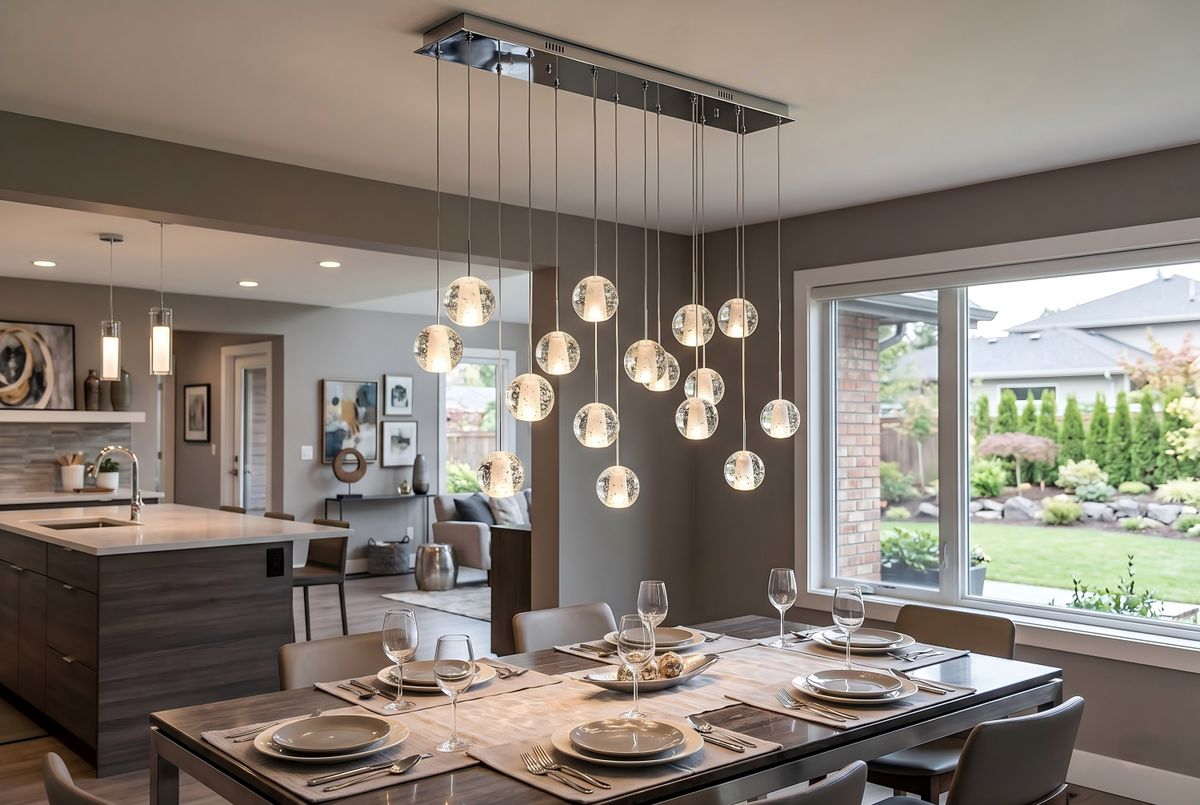
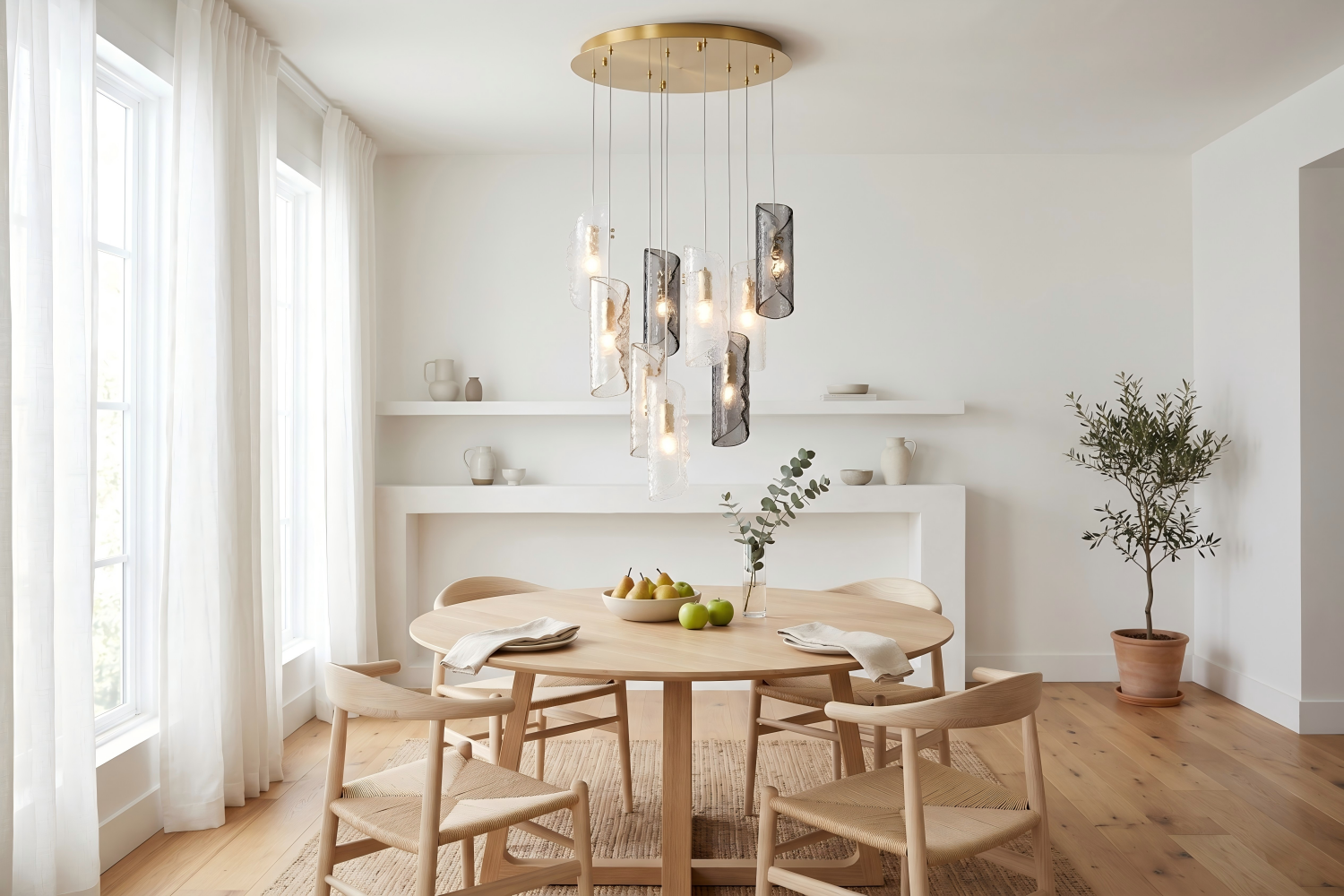
You've decided your dining room needs a chandelier. You know the style you want, the finish you love, and the budget you're comfortable with. Now you're staring at the product page and the specs say "diameter: 23.6 inches." And you have absolutely no idea if that's the right size for your room.
You're not alone. Sizing is one of the most common questions our customer service team receives. And it's the question with the most riding on the answer, because a chandelier that's the wrong size for the room is the one mistake you'll notice every single day.
This guide gives you three methods to find the right size — from a quick room-based formula to a precise table-based calculation to a hands-on visual test. Use whichever method matches how your brain works, or use all three to triangulate the perfect size.
Table of Contents
- Method 1: The Room Formula (Quick & Easy)
- Method 2: The Table Formula (Most Precise)
- Method 3: The Cardboard Test (Most Reliable)
- The Most Common Sizing Mistake
- Visual Weight: Why Two 24-Inch Chandeliers Look Different
- Open Floor Plans: Sizing Without Walls
- What If My Table Changes?
- Frequently Asked Questions
- Your 60-Second Sizing Checklist
Method 1: The Room Formula (Quick & Easy)
This is the formula that most interior designers learn first. It's fast, requires no tape measure near the table, and gets you in the right ballpark within 30 seconds.
Room length (feet) + Room width (feet) = Chandelier diameter (inches)
That's it. A 12 × 14 foot dining room: 12 + 14 = 26 inches. A 10 × 12 room: 10 + 12 = 22 inches. The sum of the room dimensions in feet converts directly to the ideal chandelier diameter in inches.
Room formula quick reference
| Room Size | Ideal Diameter | Our Recommendation |
|---|---|---|
| 8 × 10 ft | 18" | Modern Opal Glass 5-Light Round (19.6") — $699 |
| 10 × 12 ft | 22" | Luminous Waves 13-Light Round (23.6") — $1,699 |
| 12 × 14 ft | 26" | Textured Glass 12-Light Round (26") — $1,999 |
| 14 × 16 ft | 30" | Half-Ring 3-Tier (31.5") — $959 or Modern Opal 10-Light Round (31.5") — $1,299 |
| 16 × 18 ft | 34" | Half-Ring 4-Tier (39.5") — $1,345 |
| 18 × 20 ft + | 38"+ | Half-Ring 5-Tier (47.5") — $1,855 |
When the room formula works well
This method is most reliable when your dining table is proportional to the room — a 72-inch table in a 12 × 14 room, or a 48-inch round table in a 10 × 10 room. In those cases, the room formula and the table formula (below) produce similar results, so the quick version is fine.
When the room formula breaks down
The room formula can mislead you in two situations. First, open-concept spaces where the "room" doesn't have four walls. If your dining area is part of a combined living-dining-kitchen space, measuring the full room (say 20 × 30 feet) gives you a 50-inch diameter — absurdly large for the dining zone. In open floor plans, measure only the area you consider the dining zone (typically the table footprint plus 3–4 feet on each side), and use that smaller measurement in the formula.
Second, small tables in big rooms. A 42-inch round table in a 14 × 16 room. The room formula says 30 inches, but a 30-inch chandelier hanging over a 42-inch table looks disproportionately large — the fixture is almost as wide as the table itself. In this case, the table formula is more reliable.
Method 2: The Table Formula (Most Precise)
If you know your table dimensions, this method gives you the most accurate result because the chandelier relates directly to what's below it — not to the walls 8 feet away.
For round & square tables: Chandelier diameter = 1/2 to 2/3 of the table width.
For rectangular & oval tables: Chandelier length = 1/2 to 2/3 of the table length. Chandelier width = table width minus 12 inches.
The "minus 12 inches" rule for width ensures the chandelier doesn't extend past the table edge — leaving about 6 inches of clearance on each side so seated guests don't bump the fixture when standing up.
Round & square table matching chart
| Table Size | Seats | Chandelier Diameter | Our Pick |
|---|---|---|---|
| 36" round | 2–3 | 18–24" | Modern Opal Glass 5-Light Round (19.6") — $699 |
| 42" square | 4 | 21–28" | Modern Opal 7-Light Round (23.6") — $899 |
| 48" round | 4 | 24–32" | Textured Glass 12-Light Round (26") — $1,999 |
| 54" round | 6 | 27–36" | Half-Ring 3-Tier (31.5") — $959 |
| 60" round | 6–8 | 30–40" | Half-Ring 4-Tier (39.5") — $1,345 |
| 72" round | 8–10 | 36–48" | Half-Ring 5-Tier (47.5") — $1,855 |
Rectangular & oval table matching chart
| Table Size | Seats | Chandelier Length | Our Pick |
|---|---|---|---|
| 60" × 36" | 4–6 | 30–40" | Cascade Cone 10-Light Rectangle (31.5") — $1,585 |
| 72" × 42" | 6–8 | 36–48" | Modern Opal 7-Light Rectangle (40.5") — $899 |
| 84" × 42" | 8 | 42–56" | Textured Glass 10-Light Rectangular (45.2") — $1,799 |
| 96" × 42" | 8–10 | 48–64" | Textured Glass 17-Light Rectangular (57") — $3,499 |
| 108"+ × 42" | 10–12 | Two fixtures in a row | Two Modern Opal 5-Light Rectangle (27.5" each) — $699 each |
Looking for a comprehensive view of all our chandeliers by size and style? Browse our Complete Chandelier Collection — every product page includes exact dimensions and weight specifications.
Method 3: The Cardboard Test (Most Reliable)
Formulas are great for narrowing the options. But the most reliable sizing method is the one professional designers use on many projects: a physical mock-up.
How it works
- Check the product page for the chandelier's listed diameter (or length × width for rectangular configurations).
- Cut a piece of cardboard to those exact dimensions. Round chandelier? Cut a circle. Rectangular canopy? Cut a rectangle. It doesn't need to be perfect — close enough to get the visual impression.
- Tape or hang it at the planned hanging height above the table. Use a string from the ceiling with the cardboard attached at the bottom edge, hanging at 30–34 inches above the table.
- Live with it for at least 24 hours. Sit down for dinner under it. Walk past it from the kitchen. Look at it from the hallway. Notice how it relates to the table, the chairs, the walls.
- Assess. Does the cardboard feel too big? Too small? Just right? If it's off, cut a new piece at a different size and repeat.
This method sounds low-tech, and it is. That's why it works. No formula can account for the specific proportions of your room — the height of your chairs, the visual weight of your table, the proximity of the walls, the light from your windows. Only your eyes in your actual space can judge that. The cardboard costs nothing and saves you the cost of a return shipment if the sizing is wrong.
Pro tip: test at night
Do the cardboard test in the evening with your existing lights on. During the day, natural light washes out proportions and makes everything look smaller. At night, with artificial light, the cardboard circle will cast a shadow on the table that closely mimics what the chandelier's light footprint will actually look like. If the shadow covers the full table with some spillover to the edges, the size is right.
The Most Common Sizing Mistake: Going Too Small
If there's one message we want this guide to burn into your brain, it's this: almost everyone's first instinct is to choose too small.
Here's why it happens. You see a chandelier online and the diameter says 23.6 inches. You look at the product photo and it fills the frame — it looks substantial. Then you mentally picture your dining room and think "that should be big enough." But 23.6 inches is less than 2 feet across. Hold your arms 2 feet apart. That's smaller than you expected, isn't it?
Now picture that 2-foot circle hanging 30 inches above a 72-inch (6-foot) dining table. The fixture covers less than one-third of the table's length. The two end seats get almost no direct light. And from across the room, the chandelier looks like it's been shrunk — a miniature floating above a table that dwarfs it.
The reverse mistake — too large — is less common and easier to fix. A slightly oversized chandelier can be raised 2–3 inches to give it more breathing room, and the extra visual presence often looks intentional and commanding. An undersized chandelier, no matter what height you hang it at, always looks like a compromise.
The rule: when torn between two sizes, choose the larger one.
Visual Weight: Why Two 24-Inch Chandeliers Look Completely Different
Diameter alone doesn't tell the full story. Two chandeliers can share the same listed dimensions but look completely different in scale — because visual weight depends on more than physical size.
Factors that increase visual weight
- Opacity of the shades. Opaque or frosted glass shades appear larger because they're solid visual masses. The Modern Opal Glass Globe Chandelier with its milky white shades feels substantial because each globe is a visible sphere. A clear glass fixture like the Ice Cube Pendant at the same diameter would feel lighter and more airy because you can see through it.
- Number of light points. A 19-light fixture like the Luminous Waves Chandelier feels larger than a 7-light fixture at similar diameters, because there are more visual elements filling the footprint.
- Color of the frame. Dark frames (matte black) feel visually heavier than light frames (brushed gold or chrome). The matte black Multi-Arm Opal Shade Chandelier will "read" as slightly larger and more imposing than a brushed-brass fixture of the same size.
- Density vs openness. A cluster design like the Cluster Bloom Chandelier where ceramic petals pack closely together feels more solid than a spread design where shades are spaced far apart. Both might measure 30 inches across, but the cluster looks bigger.
How to use this
If the formula says you need a 26-inch chandelier and you're choosing between a dense opal cluster and an airy crystal sphere, the opal cluster could work at 23 inches while the crystal sphere might need 28 inches to fill the same visual space. Factor visual weight into your final decision — don't rely on diameter alone.
Open Floor Plans: How to Size for a Dining Zone Without Walls
Modern American homes increasingly feature combined living-dining-kitchen spaces with few or no walls defining the dining area. Sizing a chandelier for these spaces requires thinking about the dining zone, not the room.
Step 1: Define the zone
Your dining zone is the table footprint plus the space needed for chairs to push back. Typically that's the table dimensions plus 36 inches on each side where chairs sit (3 feet for a chair to be pulled out comfortably). A 72 × 42 inch table creates a dining zone of roughly 144 × 114 inches (12 × 9.5 feet).
Step 2: Size to the table, not the zone
In open floor plans, the table formula (Method 2) is always more reliable than the room formula. The chandelier needs to relate to the table below it — the walls might be 20 feet away and irrelevant to the visual relationship between fixture and furniture.
Step 3: Use the chandelier to define the zone
Here's the design insight most guides miss: in an open floor plan, the chandelier creates the dining room. It defines the ceiling boundary of an otherwise undefined zone. The warm pool of light it casts on the table and chairs says "this is the dining area" more clearly than any rug or paint color. This means the chandelier should be sized confidently — large enough to anchor the zone and create a distinct light territory that separates it from the kitchen and living areas. For open floor plans, we often recommend going to the larger end of the recommended range — fixtures like the Cluster Bloom Chandelier or Crystal Sphere Chandelier excel at defining dining zones in open spaces.
What If My Table Changes? Extension Tables & Moving
Extension tables
If your table extends from 60 inches (weeknights) to 96 inches (holidays), size the chandelier for the everyday configuration. A fixture proportioned for a 60-inch table will look slightly undersized when the table extends to 96 inches, but that happens 6 times a year — the other 359 days, the proportions will be perfect. Supplement the extended table ends with candles or buffet lamps during holiday meals.
Moving to a new home
If you move frequently or are planning a move, consider sizing slightly toward the larger end of the recommended range. A chandelier that's on the bigger side for a small dining room can simply be raised higher for more breathing room, and it will likely be perfectly proportioned in a larger dining room in your next home. An undersized fixture doesn't adapt as gracefully.
Aurorae chandeliers feature adjustable hanging heights that vary by model and configuration. Most models easily cover standard 8–12 foot ceilings, and our tallest configurations reach well beyond 177 inches — well suited for 2-story foyers and stairwells up to 20+ feet. Check the product page for your chosen fixture's specific cable length and maximum hanging height.
Frequently Asked Questions
What size chandelier do I need for a 12 × 14 foot dining room?
For a 12 × 14 foot dining room, the ideal chandelier diameter is 26 inches (12 + 14 = 26). Fixtures in the 24–28 inch range work well — for example, the Textured Glass 12-Light Round Chandelier at 26 inches ($1,999) provides commanding presence at the right scale.
How do I choose chandelier size for a rectangular dining table?
For rectangular tables, the chandelier's length should be 1/2 to 2/3 of the table length, and its width should be the table width minus 12 inches (6 inches of clearance on each side). For a 72-inch rectangular table, that means a chandelier 36–48 inches long. The Modern Opal 7-Light Rectangle at 40.5" ($899) is a good fit.
Should I get a chandelier bigger or smaller than the recommended size?
Always go bigger when in doubt. The most common sizing mistake is choosing too small — an undersized chandelier always looks like a compromise no matter what height you hang it at. A slightly oversized chandelier, on the other hand, can simply be raised 2–3 inches for more breathing room, and the extra visual presence often looks intentional and commanding.
What size chandelier for a 60-inch round table?
A 60-inch round table seats 6–8 people and needs a chandelier 30–40 inches in diameter. The Half-Ring 4-Tier Chandelier at 39.5" ($1,345) is a good match — its tiered structure adds visual interest while filling the proportions correctly.
Can I use two chandeliers over one long dining table?
Yes, for tables 108 inches (9 feet) or longer, two chandeliers in a row often look better than one oversized fixture. Space them evenly along the table's length — typically one above each "half" of the table. For a 108-inch table, two Modern Opal 5-Light Rectangle Chandeliers ($699 each) create dramatic visual rhythm without overwhelming the space.
What's the best chandelier size for an open floor plan?
In open floor plans, ignore the room dimensions and size the chandelier to the dining table using the table formula. The chandelier's job is to define the dining zone within the larger open space, so err toward the larger end of the recommended range. Dense statement fixtures like the Cluster Bloom Chandelier work especially well for anchoring dining zones in open floor plans.
Your 60-Second Sizing Checklist
- Measure your table. Length and width (or diameter if round).
- Apply the table formula. Round: diameter = 1/2 to 2/3 of table width. Rectangle: length = 1/2 to 2/3 of table length.
- Cross-check with the room formula. Room length + width (feet) = diameter (inches). If both methods agree, you're solid. If they differ, trust the table formula.
- When in doubt, go bigger. Slightly too large always looks better than slightly too small.
- Do the cardboard test. Cut, hang, live with it for a day. Then buy with confidence.
Ready to find your size? Browse our Chandelier Collection — every product page includes exact dimensions, and most fixtures are available in multiple sizes, with several offering both round and rectangle canopies. Not sure which size fits? Email us your room and table dimensions and we'll send you a specific recommendation within one business day.