
You've narrowed it down to the right style, the right finish, and the right price. Now comes the question that trips up more chandelier buyers than any other: what shape should it be?
The standard advice is simple — round table gets a round chandelier, long table gets a linear one. And that's mostly correct. But "mostly" isn't good enough when you're spending $700+ on a fixture you'll look at every single day for the next decade.
This guide goes beyond the basic rule. We'll cover exact diameter and length recommendations for every common table shape, explain the surprisingly important difference between round and rectangle canopies, tackle the kitchen island question, and show you what to do when your table doesn't fit neatly into any category.
In This Guide
- The Core Principle: Echo Your Table's Footprint
- Round & Square Tables: Sizing Guide
- Rectangular & Oval Tables: Sizing Guide
- Round Canopy vs Rectangle Canopy: The Decision Most Buyers Skip
- Kitchen Island: A Special Case
- Extension Tables: When Your Table Changes Size
- Unusual Table Shapes: Racetrack, Freeform, and L-Shaped
- The Hanging Height Cheat Sheet
- Common Mistakes to Avoid
- Your Quick Decision Checklist
The Core Principle: Your Chandelier Should Echo Your Table's Footprint
Before we get into specifics, here's the underlying logic that makes all the size recommendations make sense:
A chandelier's light falls in a cone beneath it. When that cone aligns with the table's shape, the light hits where you need it — on the plates, the glasses, the faces of the people sitting around the table. When the shapes don't match, you get uneven coverage: bright spots in the middle, dim spots at the ends, and a visual disconnect between the fixture above and the furniture below.
This isn't just about aesthetics. It's about whether the person sitting at the end of your 84-inch farmhouse table can actually see their dinner.
Round & Square Tables: Sizing Guide
Round and square tables share the same chandelier logic because their footprint radiates equally in all directions from the center. A round or globe-shaped chandelier mirrors this symmetry. For broader dining room sizing context (room dimensions, ceiling height, total square footage), see our companion dining room chandelier size guide.
The sizing formula
Your chandelier diameter should be 1/2 to 2/3 of the table's width. This range gives the fixture enough presence to be a focal point without extending so wide that seated guests might bump it when standing up.
For Aurorae fixtures, we've also matched each recommendation to a specific Aurorae product whose dimensions land inside the recommended range — no guesswork required.
| Table Shape | Table Size | Seats | Target Diameter | Our Recommendation |
|---|---|---|---|---|
| Round | 36" | 2–3 | 18–24" | Opal Glass 5-Light, Round Canopy (19.6" dia, $699) |
| Round | 42–48" | 4 | 21–32" | Opal Glass 7-Light, Round Canopy (23.6" dia, $899) |
| Round | 54–60" | 6 | 27–40" | Half-Ring 4-Tier (39.5" dia, $1,345) or Opal 10-Light Round (31.5" dia, $1,299) |
| Round | 66–72" | 8 | 33–48" | Half-Ring 5-Tier (47.5" dia, $1,855) |
| Square | 42" × 42" | 4 | 21–28" | Opal Glass 7-Light, Round Canopy (23.6" dia, $899) |
| Square | 54" × 54" | 8 | 27–36" | Opal Glass 10-Light, Round Canopy (31.5" dia, $1,299) |
Why round canopy works for both round and square tables
A round canopy distributes the pendant cables in a circular pattern, creating a light spread that radiates evenly from the center. This matches the natural geometry of both round and square tables — where every seat is roughly the same distance from the center. The visual effect is balanced and harmonious, with minimal "dead zones" at corners or ends.
When to go bigger on round tables
If you have a 60-inch or larger round table and want the chandelier to make a real statement, our Half-Ring LED Chandelier is worth a serious look. The tiered arc design reaches 39.5" (4-Tier) or 47.5" (5-Tier) in diameter — larger than most of our globe-style fixtures — and the warm gold finish creates a focal point that anchors the room. For 72-inch and larger round tables, the 5-Tier is one of the few Aurorae fixtures that hit the upper end of the recommended diameter range.
Rectangular & Oval Tables: Sizing Guide
Long tables change the equation entirely. A round chandelier centered over a 72-inch rectangular table leaves the ends in relative darkness — the light cone doesn't reach the place settings at either end. This is where linear and rectangle-canopy configurations earn their place.
The sizing formula
Two measurements matter for rectangular tables:
- Width: Chandelier should be approximately 12 inches narrower than the table width. A 42-inch-wide table calls for a fixture about 30 inches across.
- Length: Chandelier should span 1/2 to 2/3 of the table length. A 72-inch table pairs well with a 36–48 inch fixture. This ensures the two end seats receive adequate light without the fixture extending past the table edge.
| Table Shape | Table Size | Seats | Target Length | Our Recommendation |
|---|---|---|---|---|
| Rectangular | 60" × 36" | 4–6 | 30–40" | Opal Glass 7-Light, Rectangle Canopy (40.5" × 3.93", $899) |
| Rectangular | 72" × 42" | 6–8 | 36–48" | Opal Glass 7-Light, Rectangle Canopy (40.5" × 3.93", $899) |
| Rectangular | 84–96" × 42" | 8–10 | 45–56" | Opal Glass 10-Light, Rectangle Canopy (45.2" × 3.93", $1,299) |
| Rectangular | 108"+ × 42" | 10–12 | Two fixtures, ~27.5" each | Two Opal Glass 5-Light Rectangle ($699 × 2) |
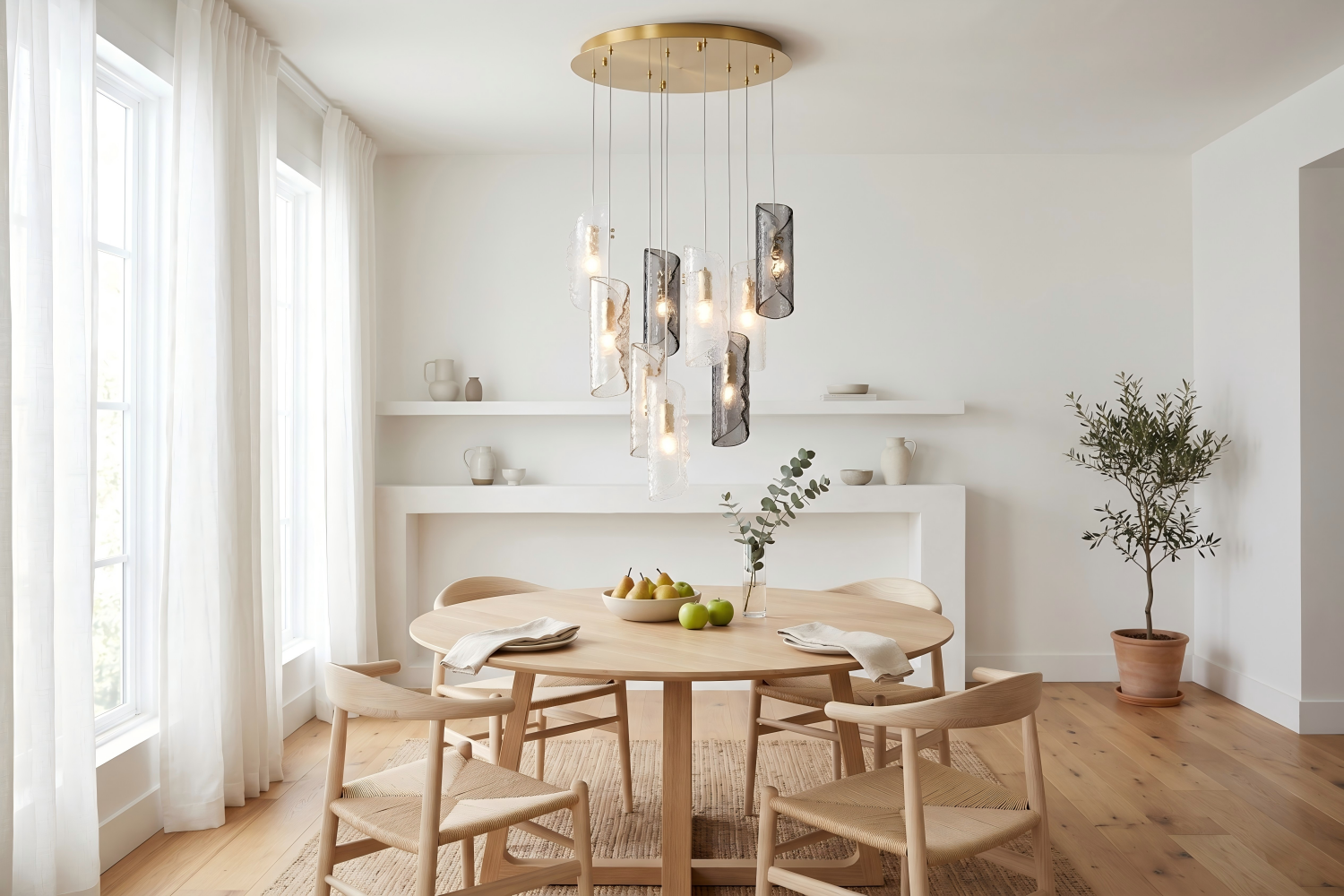
| Oval | 72" × 42" | 6–8 | 36–48" length | Cascading Textured Glass Rectangular 10-Light (45.2" × 13.7", $1,799) |
The two-chandelier solution for extra-long tables
Tables longer than 96 inches (8 feet) present a coverage challenge that a single fixture can't easily solve. The elegant answer: two identical chandeliers hung in a line, spaced evenly along the table length.
The spacing rule: divide the table into thirds. Each chandelier hangs roughly 1/3 of the table length from each end. For a 108-inch table, that means centering each fixture about 36 inches from the nearest table end, with about 36 inches between the two fixtures.
This approach actually creates a more interesting visual rhythm than a single large fixture, and it distributes light more evenly across every seat. Both fixtures should be on the same dimmer circuit so they always match in brightness.
Round Canopy vs Rectangle Canopy: The Decision Most Buyers Skip
This is the question that few other lighting guides address — because most brands only offer one canopy shape per fixture. Aurorae Lighting's Opal Glass Globe Chandelier is one of the few designs that gives you a genuine choice between round and rectangle canopy for every light count. Here's how to decide.
Round canopy
Best for: Round tables, square tables, centered installations in rooms without a dominant linear axis.
The round canopy distributes cables in a radial pattern — pendant arms extend outward from the center like spokes. This creates a circular light footprint that matches the geometry of round and square surfaces. When centered over a round table, every seat receives equal illumination.
Round canopies also work well in rooms where the chandelier isn't above a table — like a foyer, living room, or bedroom. The symmetrical form reads as balanced from every angle, regardless of which direction you approach it from.
Rectangle canopy
Best for: Rectangular tables, oval tables, kitchen islands, and any installation where the surface below is longer than it is wide.
The rectangle canopy arranges cables along a linear axis. The pendant arms extend along the length of the canopy, spreading light in an elongated footprint that mirrors the table beneath. For a 72-inch dining table, this means the pendants illuminate from one end toward the other, rather than clustering in the center.
Rectangle canopies have a more architectural feel — the clean horizontal line on the ceiling creates a sense of direction and movement that complements modern and transitional interiors.
Same light count, different footprint
Here's what's worth noting: a 7-Light Round Canopy (23.6" diameter) and a 7-Light Rectangle Canopy (40.5" long × 3.93" wide) use the same number of pendants, the same opal glass shades, and the same warm white LEDs. The difference is entirely in how the light spreads across the room. Neither is "better" — it's about matching the geometry of what's below.
Quick decision aid: look down at your table from standing height. What shape do you see? If it's roughly circular or square, choose round. If it's clearly longer than it is wide, choose rectangle.
Kitchen Island: A Special Case
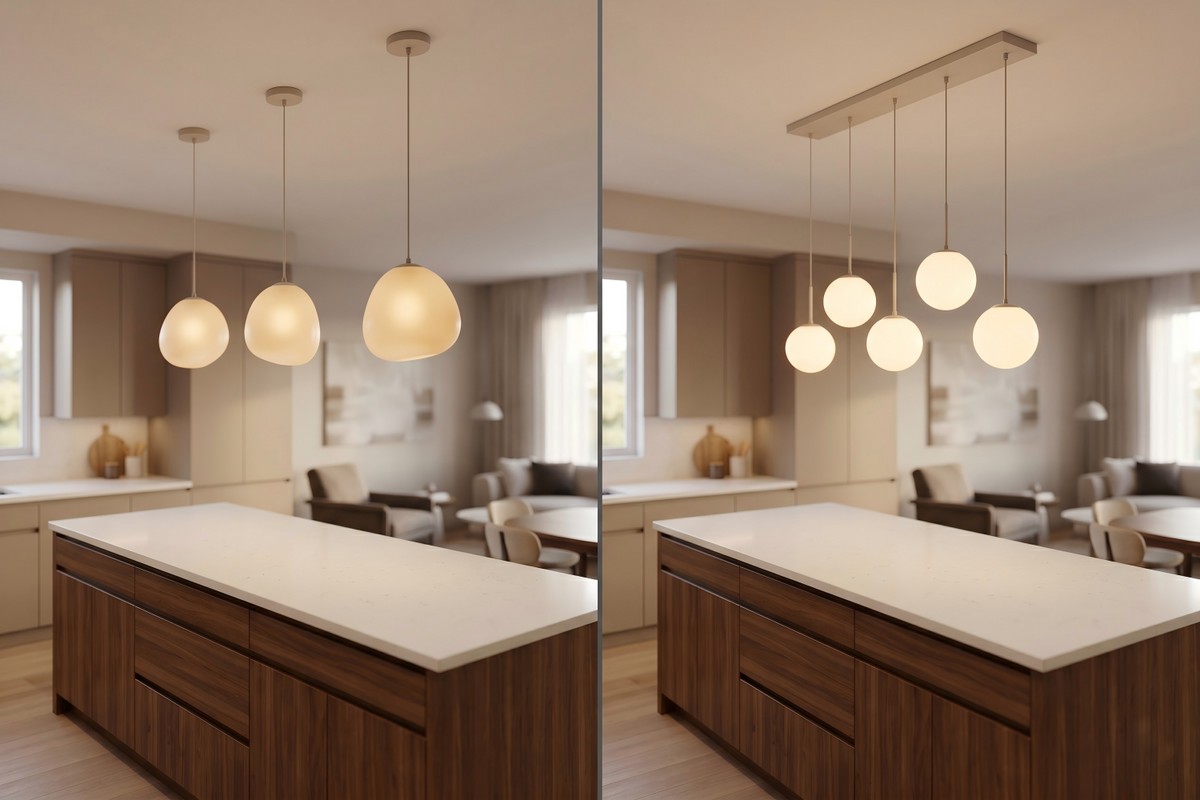
Kitchen islands aren't dining tables, and they shouldn't be lit like dining tables. The height is different (36" countertop vs 30" dining table), the activities are different (food prep, casual eating, homework), and the proportions are different (typically much longer and narrower).
Island sizing guide
| Island Length | Lighting Approach | Height Above Counter | Our Recommendation |
|---|---|---|---|
| 4 ft (48") | Cluster of 3 mini pendants or one compact rectangle fixture | 30–34" | Three Pebbles Pendants (1-Light each, $219 each) |
| 5–6 ft (60–72") | Single rectangle linear fixture | 30–34" | Cascade Cone Rectangle 10-Light (31.5" × 9.85", $1,585) |
| 7–8 ft (84–96") | Larger rectangle fixture | 30–34" | Cascade Cone Rectangle 14-Light (47.2" × 9.85", $2,366) |
| 9+ ft (108"+) | Two matching fixtures | 30–34" | Two Ice Cube Rectangle 8-Light (27.5" × 15.7" each, $892 × 2) |
Hanging height: why islands are different from dining tables
The 30–34 inch rule applies to both dining tables and kitchen islands, but the reference surface is different. Dining tables are typically 30 inches tall. Kitchen countertops are 36 inches tall. That means an island pendant fixture hangs 6 inches higher off the floor than a dining table chandelier — even though both sit 30–34 inches above their respective surfaces.
Why this matters: if your island opens to a dining area and both have pendant lighting, the island fixtures will naturally sit higher. This height difference actually helps define the boundary between the kitchen zone and the dining zone in an open floor plan — a subtle but effective way to separate spaces without walls.
The sightline test
Kitchen islands often serve as a visual divider between the kitchen and living areas. Sit down on the living room sofa and look toward the kitchen. Can you see clearly over or under the island pendants? If the fixtures block your view of the cook or the TV on the opposite wall, they're hanging too low. Raise them 1–2 inches at a time until the sightline is clear.
Spacing for cluster pendant arrangements
If you're using multiple single pendants (like three Pebbles Pendants over a 4-foot island), space them evenly along the island's centerline. A common formula: divide the island length by the number of pendants plus one. For three pendants on a 48-inch island, that's 48 ÷ 4 = 12 inches between centers, with the outer pendants 12 inches from each end.
Extension Tables: What Happens When Your Table Changes Size?
Butterfly-leaf tables, drop-leaf tables, and extension tables present a unique challenge: the table is 60 inches for weeknight dinners but 96 inches when Thanksgiving guests arrive. Your chandelier doesn't stretch with it.
The practical approach
Size for the table's everyday configuration — the length it spends 90% of its time at. If your table is 60 inches most days and 96 inches six times a year, choose a chandelier for the 60-inch version.
When the table extends for special occasions, supplement with additional lighting at the ends:
- Tall taper candles or candle holders at the extended ends add both light and festive atmosphere.
- A pair of buffet lamps on a nearby sideboard can throw ambient light toward the table ends.
- Increase the chandelier brightness to 100% (you probably run it at 60–70% on weeknights). The extra lumens reach further, partially compensating for the extended table length.
Unusual Table Shapes: Racetrack Oval, Freeform, and L-Shaped
Racetrack oval (rounded rectangle)
This increasingly popular shape — flat sides with rounded ends — is a hybrid. If the table is significantly longer than it is wide (length more than 1.5× the width), treat it as a rectangular table and use a linear fixture. If it's closer to circular proportions, a round chandelier works fine.
Freeform / live-edge tables
Organic-shaped tables with irregular edges pair surprisingly well with geometric chandeliers. The contrast between the natural form below and the architectural form above creates visual tension that reads as intentional and designed. Measure the table's longest dimension and widest point, then size as if it were a standard rectangle of those dimensions.
L-shaped dining setups
Banquette seating or L-shaped table arrangements sometimes appear in breakfast nooks. Center the chandelier over the area where the most seated faces converge — typically the inner corner of the L. A round canopy works best here because the seating radiates out from a central point.
The Hanging Height Cheat Sheet
| Location | Height Rule | Measured From |
|---|---|---|
| Dining table | 30–34 inches | Tabletop to bottom of fixture |
| Kitchen island | 30–34 inches | Countertop to bottom of fixture |
| Foyer / open space | 7 feet minimum | Floor to bottom of fixture |
| 9+ ft ceilings | Add 3" per extra foot of ceiling | Above the standard height |
Most Aurorae chandeliers are cable-hung with fully adjustable cable lengths, so dialing in the perfect height is a simple cable adjustment — no tools, no extra parts. Rod-hung models offer the same flexibility through rods of different lengths — every Aurorae fixture has an adjustable hanging height up to the maximum listed for its configuration. For a complete breakdown by room type, ceiling height, and architectural feature, see our complete hanging height guide.
Common Mistakes to Avoid
Mistake 1: Going too small "to be safe"
When in doubt, buyers almost always err toward a smaller fixture. But in practice, an undersized chandelier is far more noticeable than one that's at the larger end of the recommended range. A slightly large chandelier looks intentional and commanding. A too-small one looks like an afterthought. If you're between two sizes, choose the larger one. You can always raise it slightly using the chandelier's adjustable cable to give it more breathing room — see our hanging height guide for the exact measurements.
Mistake 2: Matching the chandelier shape to the room instead of the table
A rectangular room with a round dining table should get a round chandelier — the fixture echoes the table, not the walls. The room shape is irrelevant. Align with the surface directly below the fixture, always.
Mistake 3: Centering over the room instead of the table
If your junction box is in the center of the room but your table is offset, the chandelier should be centered over the table. Options: relocate the junction box ($300–$500 with an electrician), or use a swag hook to route the cable from the box to a hook above the table ($15–$30 DIY).
Mistake 4: Ignoring the canopy when choosing shape
The canopy determines how the pendant cables fan out. A round canopy creates a circular light spread; a rectangle canopy creates a linear one. Even if the hanging glass shades look identical, the canopy shape changes the entire light footprint. This is the decision most buyers don't realize they're making — and it matters as much as the fixture size.
Your Quick Decision Checklist
- Measure your table. Length, width, and note the shape.
- Calculate chandelier size. Round/square: diameter = 1/2 to 2/3 of table width. Rectangular: length = 1/2 to 2/3 of table length, width = table width minus 12".
- Choose your canopy. Round or square table → round canopy. Rectangular or oval → rectangle canopy.
- Set hanging height. 30–34" above the tabletop. Add 3" per extra foot of ceiling above 8 feet.
- The cardboard test. Cut a shape to your calculated size. Tape it at the planned height. Live with it for a day. Then buy with confidence.
Ready to find your match? Browse our Chandelier Collection — every fixture offers adjustable hanging height and dimmable LEDs (2700K or 3000K warm white depending on model, CRI >90), and select models including the Opal Glass Globe, Cascade Cone, Ice Cube Glass, and Cascading Textured Glass are available in both round and rectangle canopy configurations. Not sure which option fits your table? Email us a photo of your dining space and we'll send you a personalized recommendation.
Related Guides
- How to Choose the Right Size Chandelier for Your Dining Room [2026 Guide]
- How High to Hang a Chandelier: The Complete Room-by-Room Height Guide
- Chandelier Installation Cost Guide [2026]: DIY vs Electrician
- Chandelier Color Temperature Guide: How 2700K, 3000K & 4000K Actually Feel in Your Home
- 2026 Chandelier Trends: 5 Styles That Are Defining Modern Interiors