Published: April 2026 | By the Aurorae Lighting design team
You've picked the perfect chandelier. It's arrived, it's beautiful, and it's ready to go up. Now comes the question that causes more second-guessing than any other part of the process: how high should it hang?
Too high, and the chandelier floats disconnected from the room — a lonely ornament on the ceiling that doesn't relate to anything below it. Too low, and someone walks into it, bumps it standing up from dinner, or it dominates the room like a low-hanging cloud.
The good news: there are clear, proven rules for every room. The even better news: once you know the rule for your specific situation, adjusting the height is a 5-minute cable tweak, not a construction project. Let's get your chandelier at the perfect height.
Table of Contents
- The Universal Measurement Rule
- Dining Room: 30–34 Inches Above the Table
- Kitchen Island: 30–34 Inches Above the Counter
- Foyer & Entryway: 7 Feet Minimum
- 2-Story Foyer & High Ceilings: 8–10 Feet
- Living Room: 7 Feet Minimum
- Staircase: Center of the Vertical Space
- Bedroom: 7 Feet (Room) or 8 Feet (Over Bed)
- Bathroom: 7 Feet + Location Rating
- Sloped & Vaulted Ceilings
- The Complete Height Cheat Sheet
- How to Adjust Cable Height
- The String Test: Preview Before Installing
- Frequently Asked Questions
The Universal Measurement Rule (and When to Break It)
Before we go room by room, here's the one principle that applies everywhere:
A chandelier's hanging height is always measured from the bottom of the fixture — not the canopy, not the center of the body, not the top of the shades. The lowest-hanging element of the chandelier (the bottom of the lowest glass shade, the finial at the base, or the lowest pendant drop) is the reference point for every measurement in this guide.
This matters because product photos can be misleading. A chandelier that looks compact in a photo might have glass shades that extend 8 inches below the frame. Always check the fixture's "maximum drop height" and "fixture body height" in the product specifications before you install.
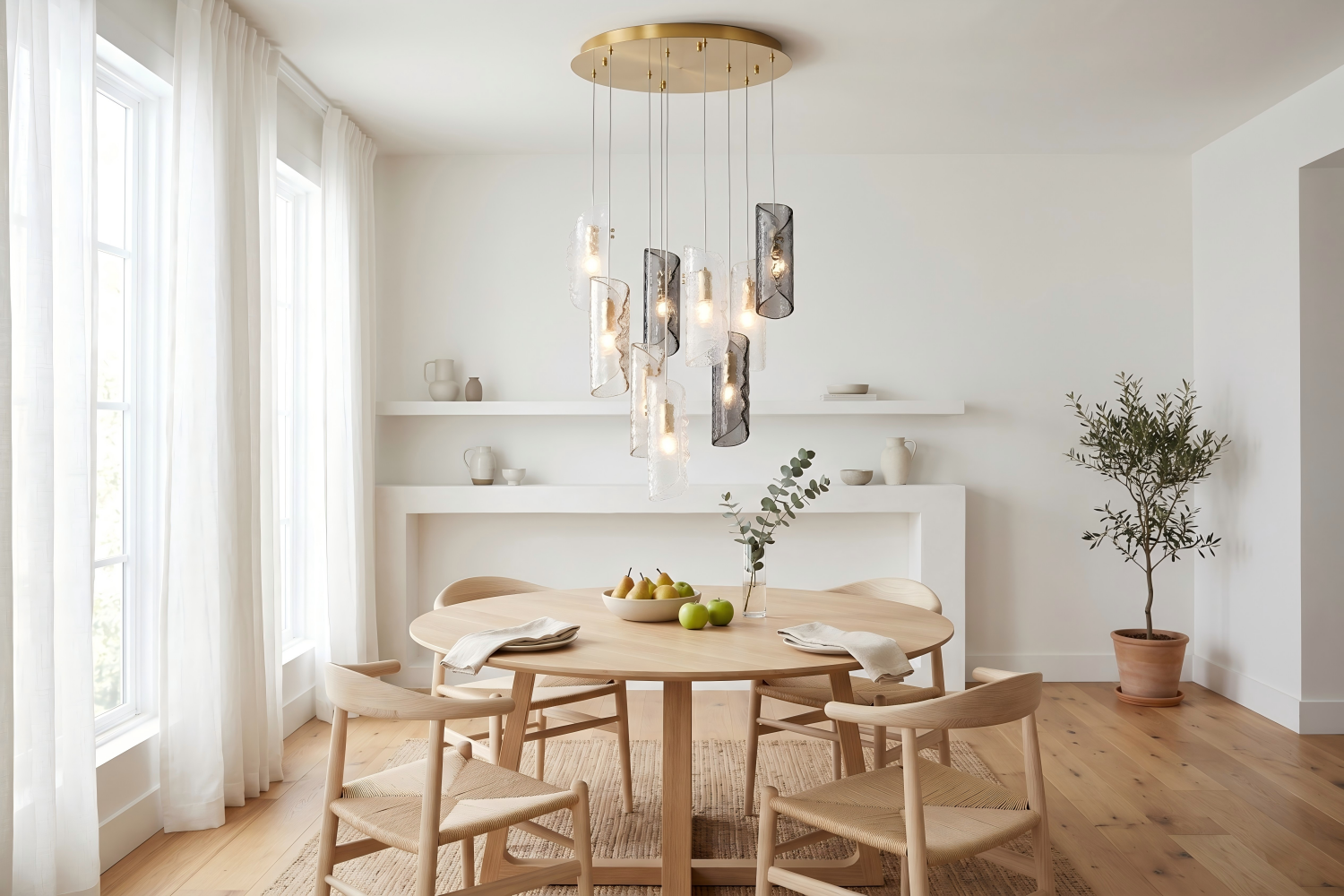
Dining Room Chandelier Height: 30–34 Inches Above the Table
This is one of the most-searched chandelier height questions in America — and the answer is precise:
The bottom of the chandelier should hang 30–34 inches above the top of the dining table.
That range isn't arbitrary. At 30 inches, the light is intimate and enveloping — close enough to create a warm, golden pool over the table that flatters food and faces. At 34 inches, the light opens up slightly — better for larger tables or rooms where you want the chandelier to illuminate a wider area beyond the table's edge. Most designers default to 32 inches as the starting point and adjust up or down based on the fixture's specific proportions.
How to measure dining chandelier height correctly
- Place a tape measure on the tabletop surface (not the floor).
- Measure straight up to where the bottom of the fixture will hang.
- Mark 30 inches and 34 inches on the cable/chain with painter's tape.
- Have someone hold the fixture (or a stand-in object) at both marks while you sit in a dining chair at the table.
- Choose the height where you can see everyone across the table clearly — the fixture should not block sightlines between seated guests.
That last point is critical and often overlooked. The rule says 30–34 inches, but your eyes are the final judge. If the fixture hangs at a perfect 32 inches but blocks your view of the person sitting across from you, raise it an inch. Sightlines beat formulas.
Ceiling height adjustment: add 3 inches per foot
The 30–34 inch rule assumes a standard 8-foot ceiling. If your ceiling is higher, the chandelier needs to hang slightly higher to maintain visual balance with the room's proportions:
| Ceiling Height | Height Above Dining Table | Calculation |
|---|---|---|
| 8 ft (standard) | 30–34" | Base rule |
| 9 ft | 33–37" | Base + 3" |
| 10 ft | 36–40" | Base + 6" |
| 11 ft | 39–43" | Base + 9" |
| 12 ft | 42–46" | Base + 12" |
The formula: add 3 inches for every foot of ceiling height above 8 feet. Simple, easy to remember, and accurate for most residential scenarios up to about 14 feet. Beyond 14 feet, you're dealing with 2-story spaces — that's a different section below.
The one mistake everyone makes
Homeowners with 9 or 10-foot ceilings almost always hang their chandelier too high on the first attempt. The logic feels right: "My ceiling is higher, so the fixture should be higher." But the extra 3 inches per foot is much less than people expect. A 10-foot ceiling only adds 6 inches — bringing the range to 36–40 inches above the table. Many homeowners set it at 48+ inches, and the chandelier ends up looking like it's retreating into the ceiling instead of relating to the table.
When in doubt, start at the lower end of the range and live with it for a day before adjusting higher. It's easier to raise a chandelier than to convince yourself to lower one that "seems fine" but actually should come down.
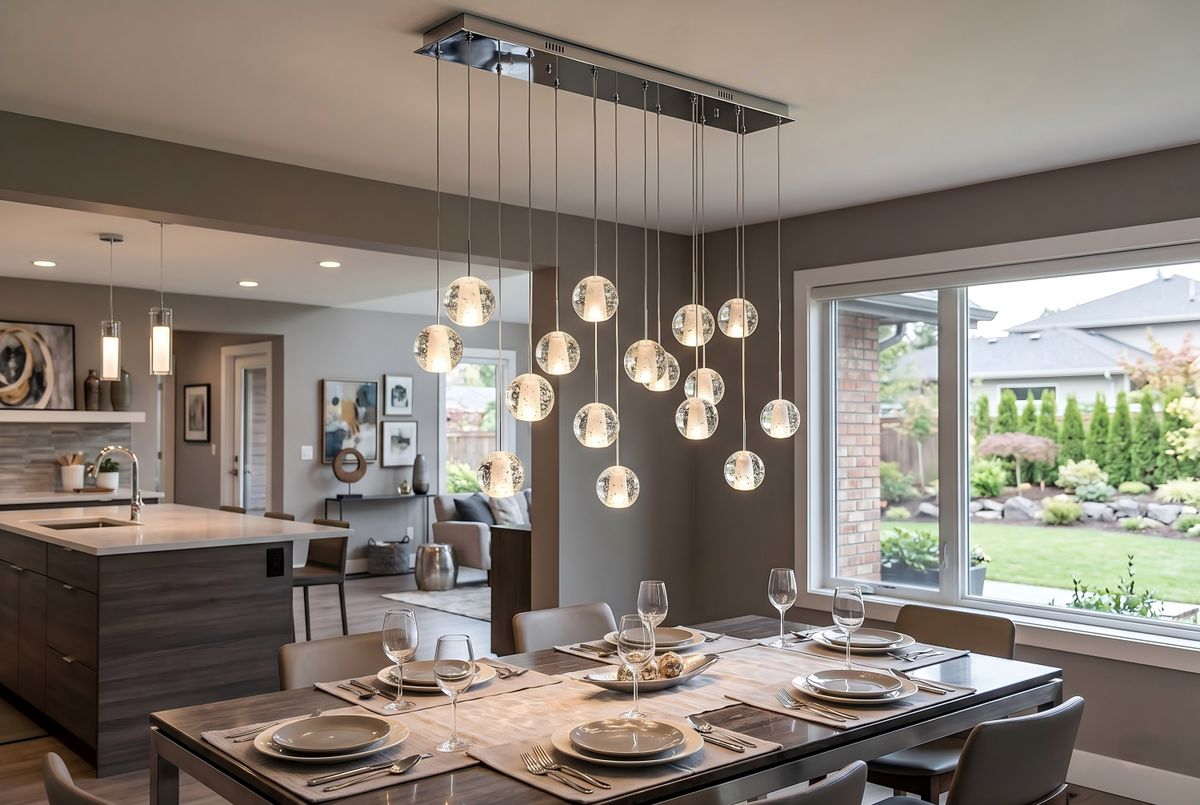
Kitchen Island Pendant Height: 30–34 Inches Above the Counter
The height number is the same as dining tables, but the reference surface is different — and that distinction matters.
The bottom of pendant lights should hang 30–34 inches above the countertop surface.
Kitchen countertops are 36 inches tall (standard) versus dining tables at 30 inches. That means island pendants hang 6 inches higher off the floor than dining chandeliers — even though both are 30–34 inches from their respective surface. In an open floor plan where you can see both fixtures simultaneously, this natural height difference actually helps visually separate the kitchen zone from the dining zone.
The sightline rule for kitchen islands
Kitchen islands often serve as a visual divider between the kitchen and living areas. Before you finalize the hanging height, do this test:
- Sit on the living room sofa in your normal position.
- Look toward the kitchen island.
- Can you see clearly over or under the pendant lights?
If the fixtures block your view of the cook, the TV, or the window beyond the kitchen, they're hanging too low. Raise them 1–2 inches at a time until the sightline is clear. In open-concept homes, this test matters more than any fixed measurement.
Bar-height islands: a different number
Some kitchen islands have a raised bar section at 42 inches high (instead of the standard 36). For bar-height counters, reduce the hanging height to 28–32 inches above the bar surface — the taller counter already eats into the headroom, so the fixture needs to compensate by sitting slightly closer to the surface.
Our picks for kitchen islands
- Pebbles Pendant Light (from $219) — Hand-blown opal glass globes in Small, Medium, or Large sizes. Perfect for creating a custom cluster of 2–4 individual pendants across the island without blocking sightlines.
- Cascade Cone Pendant (from $1,585 for 10-light rectangle canopy) — Brushed brass cones directing light onto the work surface. The rectangular canopy is designed specifically for long islands 5–7 feet.
- Brass Crystal Cube Pendant (6-light $1,532 or 10-light $2,258) — K9 crystal cubes on a brushed brass frame for bold, modern kitchen designs.
Browse all kitchen island pendants or see our full kitchen lighting collection for more options.
Foyer & Entryway Chandelier Height: 7 Feet Minimum
Foyers don't have a table to measure from, so the reference point shifts to the floor:
The bottom of the chandelier should hang at least 7 feet (84 inches) above the floor.
This ensures adequate clearance for the tallest person likely to walk through the space. If anyone in your household is 6'2" or taller, bump it to 7.5 feet (90 inches) for comfort. No one should ever feel like they need to duck under a chandelier — that instinct kills the welcoming atmosphere an entryway chandelier is supposed to create.
Standard ceiling foyers (8–9 feet)
In a standard-height foyer, you're working with limited space between the 7-foot minimum clearance and the ceiling. A small to medium fixture works best here — something with enough presence to make a statement without physically overwhelming the space.
Best picks for 8–9 foot foyers:
- Opal Glass Globe Chandelier (5-light $699) — Low-profile 5-light configuration at just 13.5–14.3 lbs, available in Gold or Matte Black with Round or Rectangle canopy. Under 50 lbs = no ceiling bracing required.
- Half-Ring LED Chandelier (3-circle 16-light $959) — Tiered brushed gold arcs with opal glass diffusers at 13.8 lbs for the 3-circle configuration.
- Grand Cascading Prismatic Crystal Chandelier ($993) — 12-light prismatic crystal with 27.5-inch canopy and 63-inch cable, ideal for foyers with 8–12 ft ceilings. Only 17.8 lbs.
Tall ceiling foyers (10–12 feet)
Higher ceilings give you room to hang a larger fixture and lower the bottom to about 7.5–8 feet above the floor. The extra vertical space between the top of the chandelier and the ceiling creates visual breathing room — the fixture looks like it belongs in the space rather than being crammed against the ceiling.
For 10–12 foot ceilings, consider fixtures with more vertical presence:
- Timeless Black Arm Opal Glass Chandelier (from $899 for 8-light) — Matte black articulated arms with hand-finished frosted opal glass shades. 92.5-inch cable on the 8-light hanging cable configuration covers the full 10–12 foot foyer range.
- Artisanal Crystal Sphere Chandelier (14-light from $885) — Available in 2700K Warm White or 6000K Cool White with round, rectangle, or square canopy. 59-inch cable on 14/26-light versions.
- Modern Chrome Crystal LED Chandelier (12-light from $1,085) — K9 crystal columns on polished chrome frame. The 12-light (70.8-inch cable) covers ceilings up to 11 feet; the 15-light (78.7-inch cable) covers up to 13 feet.
See more in our entry foyer lighting collection.
2-Story Foyers & High Ceilings: 8–10 Feet Above the Floor
Two-story foyers are chandelier territory — this is the space where a cascading fixture truly comes alive. The rules change significantly at this height:
In a 2-story foyer, the bottom of the chandelier should hang at approximately the same level as the second floor railing or landing. This positions the fixture roughly in the center of the vertical space when viewed from both the ground floor and the second-floor hallway above.
For most 2-story foyers (16–20 feet), this means the fixture bottom sits about 8–10 feet above the ground floor. The fixture itself might be 3–6 feet tall for a cascading design, placing its top at 11–16 feet — well above head height and beautifully proportioned within the tall space.
Why cable length matters for 2-story foyers
Many fixtures max out at 60–72 inches of adjustable cable, which isn't enough for 2-story installations without purchasing extension kits. Aurorae offers long cables on several models:
- The Timeless Black Arm Opal Glass Chandelier 36-light hanging cable style extends to 368 inches (over 30 feet) — the longest-reaching fixture in our collection.
- The Modern Chrome Crystal LED 40-light round canopy reaches 196.8 inches, covering ceilings up to 23 feet.
- The Opal Glass Globe Chandelier 10-light configuration reaches 177 inches (nearly 15 feet).
- The Glass Pebbles Cluster Pendant 36-light configuration reaches 177 inches.
Always check the product page for your chosen model and configuration's specific cable length.
Best picks for 2-story foyers
- Opal Glass Globe 10-Light ($1,299) — 177-inch cable reaches up to 21 ft ceilings. Available in Gold or Matte Black with Round or Rectangle canopy, all at the same price.
- Dramatic Cascading Acrylic Orb Chandelier (13-light $1,217 or 25-light $1,793) — Crystalline acrylic orbs at staggered heights. The 13-light weighs 18.5 lbs with 78.7-inch cable; the 25-light weighs 28.2 lbs with 118-inch cable. Crystal-look drama at a fraction of the weight.
- Modern Chrome Crystal LED 40-light ($3,647) — The longest-reaching crystal chandelier in our collection at 196.8-inch cable, perfect for foyers up to 23 ft.
- Glass Pebbles Cluster Pendant (from $4,032) — Hand-blown frosted glass at staggered heights. The 36-light configuration at 177-inch cable creates a dramatic foyer statement. Note: 36-light weighs 55.4 lbs and requires a fan-rated ceiling brace.
- Timeless Black Arm Opal Glass 36-light hanging cable style ($3,655) — At 368 inches of cable, this is the only fixture in our collection that reaches ceilings above 30 feet.
Living Room Chandelier Height: 7 Feet Minimum
Living rooms without a table directly beneath the chandelier follow the foyer rule: 7 feet minimum above the floor.
But living rooms have an additional consideration: furniture groupings. If the chandelier hangs over a coffee table between two sofas, people aren't walking under it — they're sitting near it. In these cases, you can lower the fixture to 6.5 feet (78 inches) above the floor for a more intimate feeling. The key is that no one in a standing position should feel like the fixture is in their way.
Open floor plans: the transition problem
In open-concept homes where the dining area, kitchen, and living room share one continuous space, you'll often have 2–3 chandeliers or pendants visible simultaneously. The hanging heights should follow each room's individual rule (30–34" above dining table, 30–34" above island counter, 7'+ in living area), but the visual effect of those different heights needs to feel intentional, not random.
The trick: let the fixture bottoms step up gradually as you move from the dining area toward the living area. The dining chandelier hangs lowest (closest to its table), the kitchen pendants sit slightly higher (because the counter is taller), and the living room fixture hangs highest (no table reference). This creates a gentle upward sweep that follows the transition from intimate dining to open living — it feels natural and designed.
Browse the living room lighting collection for fixtures sized specifically for open-concept spaces.
Staircase Chandelier Height: Center of the Vertical Space
Staircase chandeliers occupy a unique position — they're viewed from multiple levels as you ascend and descend. The goal is to position the fixture where it looks balanced from both the ground floor looking up and the upper landing looking across or down.
The center of the fixture body should align approximately with the halfway point of the stairwell's total height.
For a stairwell with a 16-foot ceiling: half is 8 feet. Position the center of the chandelier at about 8 feet above the ground floor. If the fixture body is 4 feet tall (common for cascading designs), that would put its bottom at 6 feet — too low to walk under. Raise it until the bottom is at least 7 feet above the floor or stair tread directly beneath it. Over the ground floor, that means a center at 9 feet and a top at 11 feet.
The landing clearance check
Before finalizing, walk the staircase at every point. Check that the bottom of the fixture is at least 7 feet above any stair tread, measured at the point where the fixture is closest to the stairs — people carrying boxes, children on shoulders, and tall guests with hands raised all need clearance. If your staircase wraps around the chandelier (as in a spiral or L-shaped stair), check from every angle, not just straight below.
For staircase-specific fixtures, see our staircase lighting collection. The Slim Glass Cascading Pendant (6-light $386 up to 49-light $3,062) is specifically designed for tall vertical spaces — the 49-light configuration reaches 138 inches of cable.
Bedroom Chandelier Height: 7 Feet Above Floor or 8 Feet Above Bed
Bedroom chandeliers are growing in popularity as part of the 2026 trend toward personal, boutique-hotel-inspired spaces. Two hanging positions work:
Centered over the room: 7 feet minimum above the floor (same as living room/foyer). This works when the chandelier serves as general ambient light rather than being tied to the bed.
Centered over the bed: At least 8 feet above the top of the mattress. This higher clearance accounts for the fact that people sit up in bed, stretch, and occasionally stand on the mattress (kids, changing sheets). With the mattress surface typically at 25 inches off the floor, 8 feet above the mattress puts the fixture bottom at about 10.5 feet above the floor — so this configuration really only works with 10-foot or higher ceilings.
For standard 8-foot ceiling bedrooms, center the chandelier over the room (not the bed) at 7 feet above the floor. A compact fixture like the Opal Glass Globe 5-Light ($699) with its low-profile design works well in this tight vertical space.
Bathroom Chandelier Height: 7 Feet Minimum + Location Rating
Small chandeliers and mini pendants are increasingly popular in bathrooms — particularly over freestanding tubs and in powder rooms. The height rule is the same as other non-table spaces: 7 feet minimum above the floor.
However, bathrooms have an additional requirement: location rating. Any fixture installed within 3 feet of a bathtub or shower must be Damp Rated or Wet Rated. Fixtures beyond 3 feet from water sources can be Dry Rated. All Aurorae chandeliers are Dry Rated, which means they can be installed in bathrooms as long as they're more than 3 feet from the tub or shower edge.
Sloped & Vaulted Ceilings: How to Hang Straight on an Angle
Sloped ceilings add a variable that flat ceilings don't: the fixture must hang plumb (perfectly vertical) even though the ceiling is angled. A chandelier that tilts with the ceiling slope looks wrong immediately — your eye catches the asymmetry every time you enter the room.
How chandeliers hang straight on sloped ceilings
The solution is a swivel canopy — a ceiling plate with a ball joint that allows the mounting hardware to sit flush against the angled ceiling while the fixture hangs straight down via gravity. If your ceiling is sloped, we provide a sloped-ceiling adapter at no extra cost once your ceiling angle is confirmed.
The adapter works on slopes up to about 45 degrees, which covers the vast majority of vaulted and cathedral ceilings in American homes. The canopy plate sits flush against the angled surface, the ball joint inside pivots to the ceiling's angle, and the cable drops straight down from the pivot point.
Where to position the fixture on a sloped ceiling
On a flat ceiling, the chandelier hangs from the center of the room. On a sloped ceiling, the "center" is ambiguous — do you mean the center of the floor plan, or the center of the sloped plane?
Always position based on the floor plan, not the ceiling. Find the center point of the table or room at floor level, then go straight up to wherever the ceiling is at that point. The fixture should hang plumb over the table regardless of what the ceiling is doing above it. If the ceiling is higher at the center point than at the edges, you'll have extra cable length to work with — which is fine. If the ceiling is lower at the center, make sure the fixture still clears the 30–34 inch (table) or 7-foot (floor) minimum.
Cathedral ceilings with a peak
The peak of a cathedral ceiling is tempting as a mounting point because it's the highest spot and creates the most dramatic drop. This works well if the peak is directly above the table or the center of the room. If the peak is offset (as in asymmetric vaulted ceilings), mounting at the peak means the fixture hangs off-center relative to the furniture below — which looks odd. In that case, mount the junction box at the ceiling point directly above the table center, even if it's not the peak. An electrician can relocate the box for $200–$400 (see our Installation Cost Guide).
The Complete Chandelier Height Cheat Sheet
| Room | Hanging Height | Measured From | Ceiling Adjustment |
|---|---|---|---|
| Dining room | 30–34" | Tabletop to fixture bottom | +3" per foot above 8ft ceiling |
| Kitchen island | 30–34" | Countertop to fixture bottom | +3" per foot above 8ft ceiling |
| Bar-height island | 28–32" | Bar surface to fixture bottom | +3" per foot above 8ft ceiling |
| Foyer (8–9ft) | 7ft minimum | Floor to fixture bottom | Can lower to 7ft regardless of ceiling |
| Foyer (10–12ft) | 7.5–8ft | Floor to fixture bottom | Use vertical fixtures to fill height |
| 2-Story foyer | 8–10ft | Floor to fixture bottom | Center body at 2nd floor railing level |
| Living room | 7ft minimum | Floor to fixture bottom | 6.5ft OK over coffee table seating |
| Staircase | Center at midpoint of total height | Viewed from both levels | 7ft min above any tread |
| Bedroom (over room) | 7ft minimum | Floor to fixture bottom | Standard rules apply |
| Bedroom (over bed) | 8ft minimum | Mattress top to fixture bottom | Requires 10ft+ ceiling |
| Bathroom | 7ft minimum | Floor to fixture bottom | 3ft+ from tub (Dry Rated fixtures) |
How to Adjust Hanging Height on Any Aurorae Chandelier
Most Aurorae chandeliers are cable-hung with adjustable cable length — ranging from 45 inches on compact models (63 inches on the Textured Glass Orb and Vertical Prismatic Crystal) to 368 inches on our longest configuration (the Multi-Arm Opal Glass 36-light hanging cable style). Rod-hung models reach the target height through rods of different lengths. Here's how to adjust it:
- Turn off the power at the breaker. Not just the switch — the breaker. Safety first, always.
- Lower or unscrew the canopy cover to expose the cable connections inside.
- To raise the fixture (shorten cable): Pull excess cable up through the canopy and coil it neatly inside the canopy cavity. Most Aurorae canopies have room to store 2–4 feet of excess cable.
- To lower the fixture (lengthen cable): Release coiled cable from inside the canopy and let it feed through.
- Re-secure the canopy flush against the ceiling.
- Restore power and verify the height.
Pro tip: Have someone hold a tape measure from the reference surface (tabletop or floor) while you adjust from the ladder. This real-time measurement is far more accurate than adjusting, climbing down to check, climbing back up, and repeating. One person measuring, one person adjusting — done in 5 minutes.
If you installed the chandelier yourself and later realize the height needs to change, this is a no-cost, no-tools adjustment. If an electrician installed it and you want to tweak the height, you can safely do this adjustment yourself — it doesn't involve any wiring, just cable management inside the canopy. See our Installation Cost Guide for when to DIY versus hiring a professional.
The String Test: Preview Before You Install
Don't want to guess? Here's the simplest pre-installation test that professional designers use:
- Cut a piece of string to the length of your planned cable drop (from ceiling to where the fixture bottom will hang).
- Tape a paper plate or a piece of cardboard (roughly the diameter of your chandelier) to the end of the string.
- Tape the other end of the string to the ceiling at the mounting point.
- Sit in your dining chair, stand in the foyer, walk the staircase — experience the fixture's position from every angle you'll normally encounter it.
- Adjust the string length until the position feels right.
- Measure the final string length. That's your cable drop.
It takes 10 minutes and removes most of the "did I hang it too high/low?" anxiety. Especially valuable for 2-story foyers and stairwells where getting the height wrong means a second trip up a very tall ladder.
Frequently Asked Questions
How high should a chandelier hang above a dining table?
The bottom of the chandelier should hang 30–34 inches above the dining tabletop. Start at 32 inches for standard 8-foot ceilings, and add 3 inches for every foot of additional ceiling height (so 33–37" for 9-foot ceilings, 36–40" for 10-foot ceilings). The final height should preserve clear sightlines between seated guests across the table.
How high should pendants hang above a kitchen island?
Pendants should hang 30–34 inches above the kitchen island countertop surface. Because kitchen counters are 36 inches tall (versus 30 inches for dining tables), island pendants hang 6 inches higher off the floor than dining chandeliers. For bar-height counters at 42 inches, reduce the hanging height to 28–32 inches above the bar surface.
How high should a foyer chandelier hang?
The bottom of a foyer chandelier should hang at least 7 feet (84 inches) above the floor. For taller ceilings between 10–12 feet, position the fixture bottom at 7.5–8 feet. For 2-story foyers (16+ feet), the fixture bottom should sit approximately level with the second-floor railing — typically 8–10 feet above the ground floor.
Can I adjust the height of a chandelier after installation?
Yes. Most Aurorae Lighting chandeliers have adjustable cable length ranging from 45 inches on compact models to 368 inches on large configurations (like the Multi-Arm Opal Glass 36-light hanging cable style). Turn off the power at the breaker, open the canopy cover, and coil or release cable inside the canopy cavity. The adjustment takes 5 minutes and requires no wiring work.
Do Aurorae chandeliers work on sloped or vaulted ceilings?
Yes. The adapter uses a swivel canopy with a ball joint that pivots flush against angled ceilings, allowing the fixture to hang plumb. If your installation involves a sloped or vaulted ceiling, we provide the adapter at no extra cost once your ceiling angle is confirmed.
Which Aurorae chandelier is best for a 2-story foyer?
For 2-story foyers, cable length is the critical specification. The Multi-Arm Opal Glass 36-light hanging cable style ($3,655) reaches 368 inches — the longest in our collection, covering ceilings up to 37 feet. For ceilings up to 23 feet, the Modern Chrome Crystal LED 40-light ($3,647) reaches 196.8 inches. For ceilings up to 21 feet, the Opal Glass Globe 10-light ($1,299) and Glass Pebbles 36-light ($8,999) both reach 177 inches. The Dramatic Cascading Acrylic Orb 25-light ($1,793) offers a crystal-look option at 28.2 lbs with a 118-inch cable.
Can I install a chandelier in a bathroom?
Yes, with a location rating consideration. All Aurorae chandeliers are Dry Rated, which means they can be installed in bathrooms as long as the fixture is more than 3 feet from the bathtub or shower edge. For fixtures within 3 feet of water sources, you need a Damp Rated or Wet Rated fixture.
What is the best Aurorae chandelier for an 8–9 foot ceiling dining room?
For standard 8–9 foot ceilings, the Opal Glass Globe 5-Light ($699) is our top pick — it weighs just 13.5–14.3 lbs, comes in Gold or Matte Black with Round or Rectangle canopy, and ships with 2700K dimmable LED bulbs included. The Luminous Waves Hand-Blown Frosted Wave Chandelier 7-light ($997) and Cascading Textured Glass 7-light ($1,299) are also strong choices at this ceiling height, each with unique hand-blown glass character.
About the Aurorae Lighting Design Team — We are a lighting retailer specializing in modern chandeliers and pendant lights. Our team reviews every fixture for dimmer compatibility, color rendering accuracy, and installation feasibility before it enters the collection. We ship to 30 countries, including all 50 US states. Every fixture is UL Listed and backed by a 4-year warranty with free parts replacement. Questions about any recommendation in this guide? Reach us at info@auroraelighting.com.
Related Guides
- Chandelier Installation Cost Guide [2026]: DIY vs Electrician
- Chandelier Color Temperature Guide: 2700K vs 3000K vs 4000K
- 2026 Chandelier Trends: 5 Styles Defining Modern Interiors