Published: April 2026 | By the Aurorae Lighting design team
Have you ever noticed how you look amazing in a candlelit restaurant — warm skin, bright eyes, the whole table glowing — but then catch your reflection under the bathroom fluorescents at home and wonder what happened?
That is not magic. It is not the wine. It is chandelier color temperature and CRI — two numbers printed on every light bulb and built into every chandelier, yet almost never explained in a way that actually helps you choose the right fixture for your dining room, kitchen, or living room.
This guide changes that. By the end, you will know exactly what those numbers mean for your daily life, which color temperature settings work best in each room of your home, and how to use dimming to turn one chandelier into a lighting chameleon that adapts from homework sessions to dinner parties to movie nights.
In This Guide
- Color Temperature Explained: 2700K vs 3000K vs 4000K
- CRI: The Number That Changes How Your Home Looks
- Room-by-Room Color Temperature Recommendations
- How One Chandelier Becomes Four Different Lights
- Color Temperature and Your Body Clock
- Common Mistakes to Avoid
- What Every Aurorae Chandelier Delivers
Color Temperature: The Warmth of Your Light, Explained Simply

Color temperature is measured in Kelvins (K). The number tells you whether a light source looks warm and golden or cool and blue-white. Here is the part that trips people up: lower numbers are warmer, higher numbers are cooler. It is counterintuitive, but once you see it in context, it makes sense.
What 2700K, 3000K, and 4000K Actually Feel Like
Forget the technical jargon. Here is what you would experience walking into a room lit at each level:
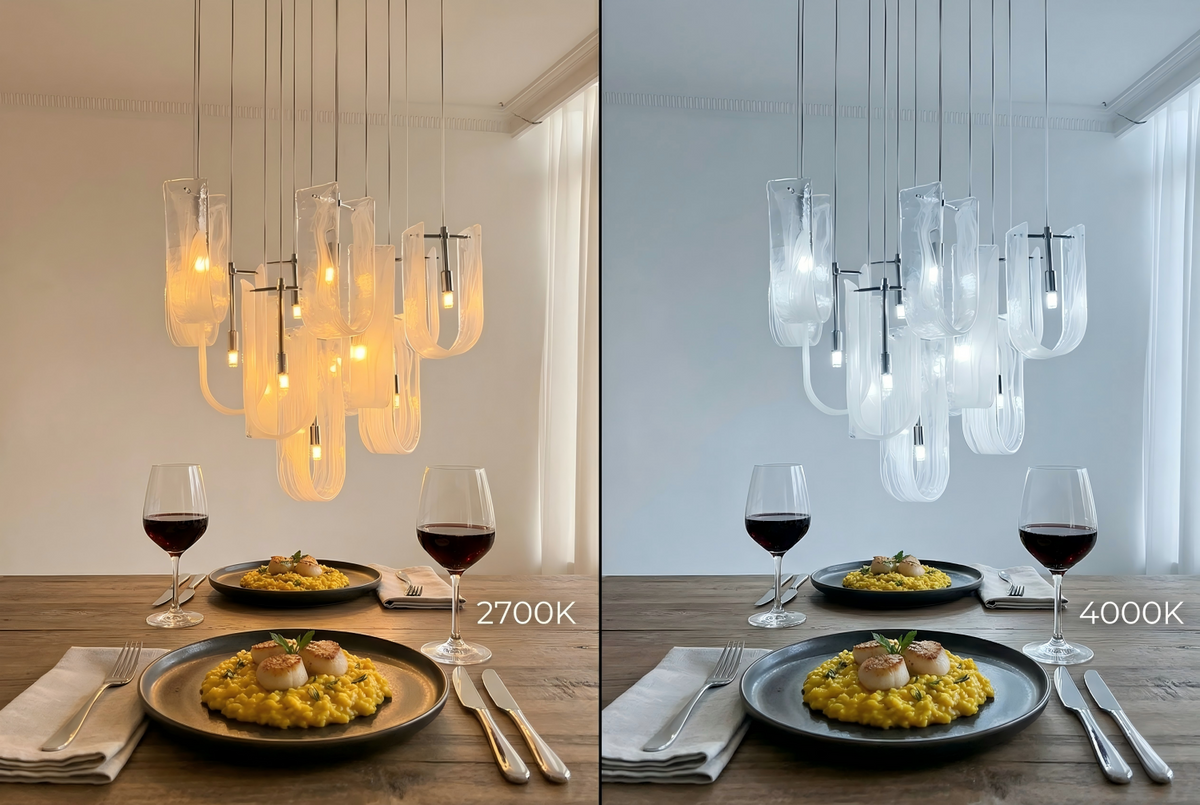
2700K — "Candlelight dinner at your favorite restaurant"
This is the warm, golden glow that makes everything feel intimate and inviting. Skin looks healthy and smooth. Wood furniture looks richer. Food on the table looks more appetizing. It is the color of late afternoon sunlight streaming through a window, or a room full of candles. When people say a space feels "cozy" or "romantic," they are almost always describing 2700K light. This is the color temperature used by luxury hotels, high-end restaurants, and upscale cocktail bars — and it is the primary color temperature across the Aurorae Lighting chandelier collection.
3000K — "Boutique hotel lobby"
Slightly brighter and crisper than 2700K, but still firmly in the warm family. Think of walking into a well-designed hotel — it is warm enough to feel welcoming but bright enough that you can comfortably read the menu or sign the check-in form. This is a versatile middle ground that works in kitchens and bathrooms where you want warmth without sacrificing visibility. In our collection, select crystal and clear glass models ship at 3000K — including the Chrome Crystal LED Chandelier and Slim Glass Cascading Pendant.
3500K — "Upscale retail store"
The neutral zone. Neither warm nor cool. Clothing stores use this temperature because it renders colors accurately without adding a yellow or blue cast. It is functional and clean but lacks the emotional warmth of lower temperatures. Rarely used in homes except in dedicated workspaces.
4000K — "The Apple Store"
Bright, clean, energizing. This is the "wide awake" light that makes spaces feel modern, crisp, and productive. It is excellent for home offices, garages, and task areas where alertness matters more than ambiance. In a living room or bedroom, though, it feels clinical — like you accidentally left the dentist office lights on.
5000K and above — "Hospital corridor"
Blue-white, harsh, institutional. There is almost no residential application for 5000K+ light. If your home currently has this color temperature, replacing those bulbs may be the single biggest improvement you can make to how your home feels.
CRI: The Number That Actually Changes How Your Home Looks
Color temperature gets most of the attention, but CRI (Color Rendering Index) is the number that quietly determines whether your home looks beautiful or just okay.
CRI measures how accurately a light source reveals the true colors of objects, on a scale from 0 to 100. Sunlight is the benchmark at CRI 100 — under sunlight, every color appears exactly as it is. The closer a light source gets to 100, the more natural and vibrant everything looks under it.
What CRI Differences Look Like in Real Life
CRI 80 (standard LED, what most cheap fixtures use):
Colors are fine. Not wrong, but not exciting either. Your red throw pillow looks a bit muted. The steak you just grilled looks brownish instead of that beautiful seared crust. Skin tone is accurate but flat — like a photo taken on a cloudy day. You would not notice anything wrong unless you compared it side-by-side with better light. It is the lighting equivalent of a phone camera in auto mode: technically correct but missing the richness.
CRI 90+ (what all Aurorae Lighting chandeliers deliver):
This is where the difference becomes visceral. That same red pillow suddenly pops with depth and saturation. The steak looks like it belongs in a food magazine. Skin tones gain warmth and dimension — your guests look healthy, rested, attractive. Wood grain reveals its full character. Artwork on your walls shows colors the artist actually intended. It is the lighting equivalent of a professional camera with perfect white balance: everything just looks right.
CRI 95+ (professional photography studios):
The gold standard for commercial and creative applications. Galleries, photo studios, and cosmetic counters use this level. For residential use, CRI 90+ delivers virtually the same visual experience at a fraction of the cost.
Why CRI Matters More Than Most People Realize
Consider how much time you spend in your home under artificial light. On winter evenings, that is 5 to 6 hours or more. Every surface, every face, every meal you see during those hours is filtered through whatever CRI your light fixtures deliver.
Upgrading from CRI 80 to CRI 90+ is like switching from a foggy window to a clean one — you see the same room, but it looks noticeably better in ways that are hard to pinpoint but impossible to unsee.
Here is a practical test: take a photo of your dinner table under your current lighting, then take the same photo in natural daylight. If the colors look dramatically different, your current CRI is probably below 85. With CRI 90+ fixtures, those two photos would look remarkably similar.
Room-by-Room Color Temperature and CRI Recommendations
Not every room needs the same light. Here is what works best based on how each space is actually used:
| Room | Best Color Temp | Minimum CRI | Why |
|---|---|---|---|
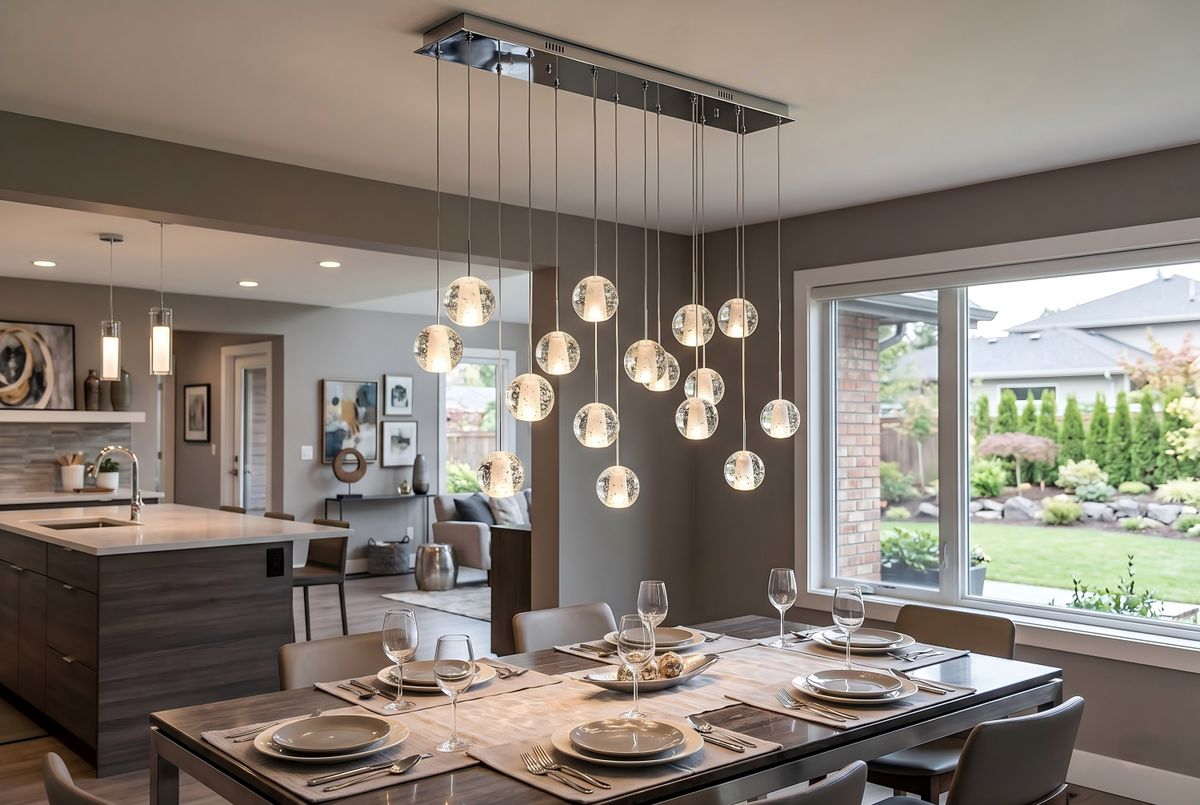
| Dining Room | 2700K | 90+ | Food colors need to look appetizing. Skin tones should be flattering for guests. The warm glow sets the mood for conversation and connection. |
| Living Room | 2700 to 3000K | 85+ | Primary relaxation space. Warmth is essential. CRI 85+ ensures your furniture, art, and textiles look their best. |
| Kitchen | 3000 to 3500K | 90+ | Slightly brighter for safe food prep and accurate color judgment (is that chicken cooked through?). High CRI is critical for seeing true food colors. |
| Bedroom | 2700K | 80+ | The warmest setting supports your circadian rhythm. Blue-shifted light (3500K+) suppresses melatonin production, making it harder to fall asleep. |
| Foyer and Entryway | 2700 to 3000K | 85+ | The first impression when entering your home. Warm light signals "welcome" in a way that cool light simply cannot. |
| Home Office | 3500 to 4000K | 85+ | Cooler light promotes alertness and focus. Essential during daytime work hours. Consider warming it to 2700K after hours if the space doubles as personal use. |
| Bathroom | 3000K | 90+ | Accurate skin tone rendering is essential for grooming and makeup application. Pure warm (2700K) can obscure details; 3000K balances accuracy with warmth. |
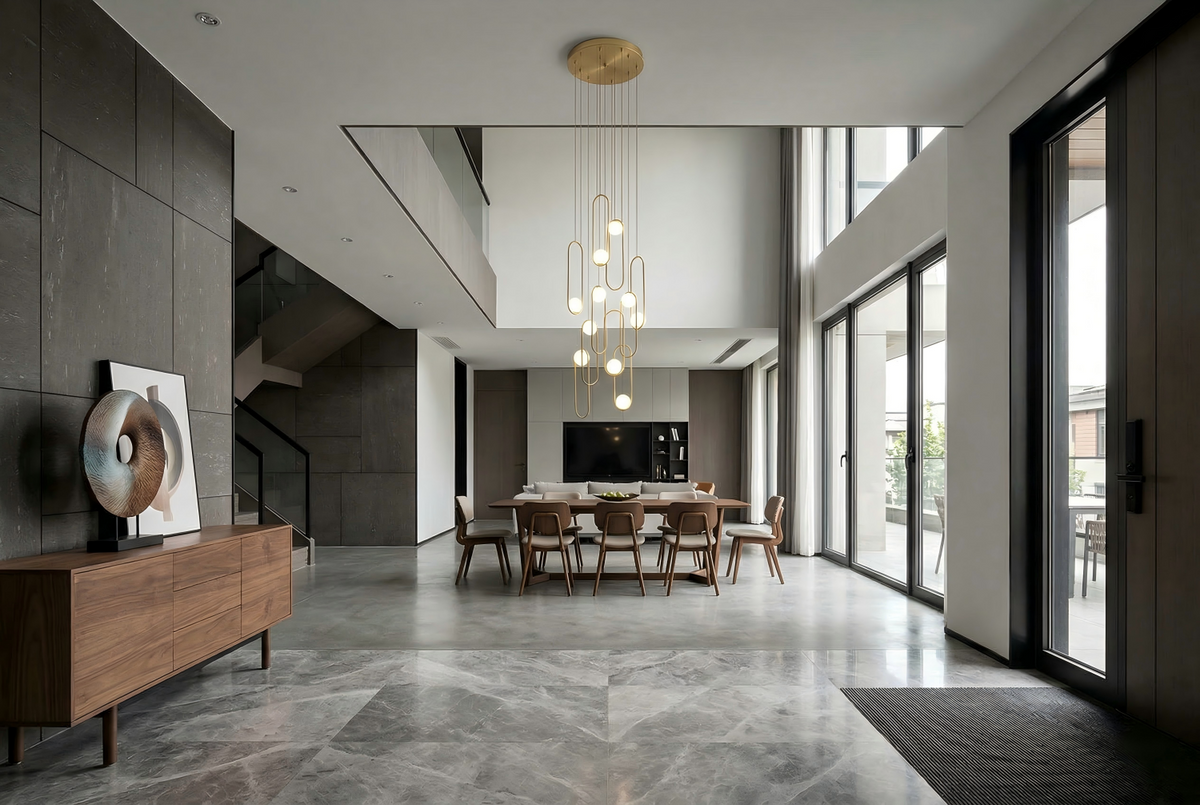
| Staircase | 2700K | 80+ | Warm light at staggered heights creates depth and drama as you ascend. The chandelier here is as much about visual art as illumination. |
Notice a pattern? For every room where people gather, eat, relax, or make first impressions, 2700K with CRI 90+ is the gold standard. This is exactly why most Aurorae Lighting chandeliers ship with 2700K warm white LEDs at CRI above 90 — it is the most universally flattering combination for residential spaces. Select crystal and glass models ship at 3000K, which is slightly cooler but still firmly in the "evening-friendly" range.
For specific fixture recommendations by room, see our guides for dining rooms, kitchen islands, 2-story foyers, and open-concept living rooms.
The Dimmer: How One Chandelier Becomes Four Different Lights
Here is something many homeowners overlook: a dimmable chandelier is not one light — it is an infinite range of lights, each creating a completely different atmosphere in the same room.
Think about your dining room on a typical week:
- Monday 6 pm — Kids doing homework at the table. You need bright, functional light. Dimmer at 100%. The chandelier delivers full illumination with clear, even coverage.
- Wednesday 7 pm — Family dinner. You want warm and comfortable but still bright enough to see each other clearly. Dimmer at 60 to 70%. The glow softens, the room feels warmer, everyone relaxes.
- Saturday 8 pm — Dinner party with friends. You want atmosphere, intimacy, flattery. Dimmer at 35 to 40%. The chandelier becomes a warm halo. Faces are lit by golden light. The room feels like a restaurant you would actually want to go to.
- Sunday 9 pm — Movie on the couch, chandelier as background glow. Dimmer at 10 to 15%. Just enough light to navigate the room without disrupting the screen. The fixture becomes ambient sculpture.
That is four completely different experiences from a single fixture — no additional hardware, no smart bulb apps, no complicated setup. Just a dimmer switch and a dimmable chandelier.
The Dimmer Switch That Eliminates Flickering and Buzzing
Not all dimmers are created equal — and using the wrong one with LED fixtures causes the flickering, buzzing, and "will not turn off completely" problems that give dimmers a bad reputation.
Every Aurorae chandelier is compatible with these two Lutron dimmer models:
- Lutron Diva (DVCL-153P) — $25 to $40. A physical slide dimmer installed in your wall. Slide up for brighter, slide down for dimmer. No app, no WiFi, no learning curve. Best for anyone who wants reliable dimming without technology.
- Lutron Caseta Wireless — approximately $60. Controls via the Lutron app, Alexa, Google Home, or Apple HomeKit. Set schedules (auto-dim to 20% at 9 pm), create scenes ("Dinner Party" sets all fixtures to 40%), or adjust from the couch. Best for smart home setups and automated lighting scenes.
If you are having an electrician install your chandelier, ask them to swap the wall switch for a Lutron dimmer at the same time — it typically adds only $50 to $100 to the total job since they are already on-site.
The Science Behind the Feeling: Color Temperature and Your Body Clock
There is a biological reason why 2700K light feels so good in the evening: it aligns with your circadian rhythm.
Your body uses light color as a signal for what time of day it is. Blue-rich light (4000K and above) mimics midday sun and tells your brain to stay alert — it suppresses melatonin, the hormone that helps you fall asleep. Warm light (2700K) mimics sunset and signals your body to wind down.
This is why scrolling your phone in bed (blue-white screen) makes it harder to sleep, while sitting by a fireplace (warm golden light) makes you drowsy. Your chandelier plays the same role at a room-wide scale.
Using 2700K light in your dining room, living room, and bedroom during evening hours is not just an aesthetic choice — it is a wellness strategy. Your sleep quality, your morning energy levels, and even your mood are influenced by the color of light you expose yourself to in the hours before bed. For a practical dimming schedule that supports your circadian rhythm, see the human-centric lighting table in our 2026 Chandelier Trends guide.
Common Color Temperature Mistakes to Avoid
Mistake 1: Mixing Color Temperatures in the Same Room
If your chandelier is 2700K but your recessed can lights are 4000K, the room will look unsettled — warm golden light from above and cool blue-white from the perimeter. Your eye constantly adjusts between the two, creating subtle visual fatigue. When layering multiple light sources in one room, keep them within 300K of each other (for example, a 2700K chandelier with 3000K accent lights is fine; 2700K with 4000K is not).
Mistake 2: Judging Color Temperature by the Bulb Box Photo
Product photos on packaging are notoriously unreliable for representing actual light color. The only reliable indicator is the Kelvin number. If a bulb says "Warm White" but lists 3500K, it will feel significantly cooler than a bulb that says "Soft White" at 2700K. Always check the number, not the marketing label.
Mistake 3: Assuming Brighter Means Better
A common reflex is to choose the brightest possible bulb. But in living spaces, excessive brightness creates glare, flattens shadows, and eliminates the depth that makes rooms feel designed rather than simply lit. CRI matters more than raw lumens for residential ambiance. A 2700K, CRI 90+ fixture at 60% brightness will make your room look dramatically better than a 4000K, CRI 80 fixture at full blast. For more on how brightness and energy efficiency relate, see our LED comparison guide.
Mistake 4: Ignoring CRI When Buying Replacement Bulbs
If your chandelier uses replaceable bulbs (most Aurorae fixtures use E14, G9, G4, or E26 depending on the model), the bulbs you choose matter. A beautiful fixture paired with CRI 70 bargain-bin bulbs will look noticeably worse than the same fixture with CRI 90+ bulbs. When replacing bulbs, always check the CRI rating on the packaging — it is usually in the fine print. Spend the extra $2 to $3 per bulb for CRI 90+. Your room will thank you.
What Every Aurorae Chandelier Delivers
We chose warm white as the foundation of our entire collection because we believe it is the right answer for home lighting:
- Warm White LEDs (2700K on most models, 3000K on select crystal and glass designs) — The same golden-hour warmth used in luxury hotels and fine-dining restaurants. Both 2700K and 3000K fall within the warm white range that supports evening relaxation and circadian health. The exact color temperature for each fixture is listed on the product page. Five models ship at 3000K: the Chrome Crystal LED, Glass Pebbles Cluster, K9 Crystal Spiral, Modern Crystal Ball, and Slim Glass Cascading Pendant.
- CRI above 90 — Colors look naturally vibrant. Food looks more appetizing. Skin tones glow. Your furniture and art reveal their full richness. No Instagram filter needed.
- High luminous efficiency (115 to 120 LM/W on E14, G4, G9, and integrated-LED models) — High light output per watt means you get the brightness you need at a fraction of the energy cost. Our Opal Glass 5-Light Chandelier uses just 15W total — a quarter of a single 60-watt incandescent bulb — while illuminating an entire dining room.
- Flicker-free operation — No strobing, no pulsing. Smooth, steady light at every dimming level with an LED-compatible dimmer.
- Lutron dimmer compatible — Compatible with Lutron Diva and Caseta dimmers for dimming from 100% down to 10%.
This combination — warm white (2700K to 3000K, with a 6000K cool white option on select designs), CRI above 90, dimmable, Lutron-compatible — is the foundation of every fixture in our Chandelier and Pendant Light collections. UL Listed for US and Canada, CE certified for European markets. It is not a premium add-on. It is the baseline.
A Simple Experiment You Can Do Tonight
Want to see the difference color temperature and CRI make in your own home? Try this:
- Tonight at dinner, take a photo of your table setting under your current lighting. Note how the food, the plates, and the faces look.
- Then take the same photo in natural daylight (near a window during the day).
- Compare the two photos side by side.
If there is a dramatic difference in color richness, warmth, and skin tone flattery, your current fixture is likely running at low CRI, high color temperature, or both. That gap between "how my home looks by day" and "how it looks at night" is exactly what a 2700K, CRI 90+ chandelier closes.
Ready to bring golden-hour light into your home every evening? Browse our complete Chandelier Collection — every fixture offers warm white light at CRI above 90, with dimmable LEDs included and Lutron Diva and Caseta compatibility.
Not sure which fixture is right for your space? See our Chandelier Guide by Home Style for room-by-room recommendations, or email us a photo of your room and we will recommend specific fixtures and configurations tailored to your ceiling height, table dimensions, and personal aesthetic.
About the Aurorae Lighting Design Team — We are a lighting retailer specializing in modern chandeliers and pendant lights. Every fixture is carefully inspected, tested, and packed to order. We ship to 30 countries, including all 50 US states. Questions about any recommendation in this guide? Reach us at info@auroraelighting.com.
Related Guides
- 2026 Chandelier Trends: 5 Styles Defining Modern Interiors
- Chandelier Installation Cost Guide [2026]: DIY vs Electrician