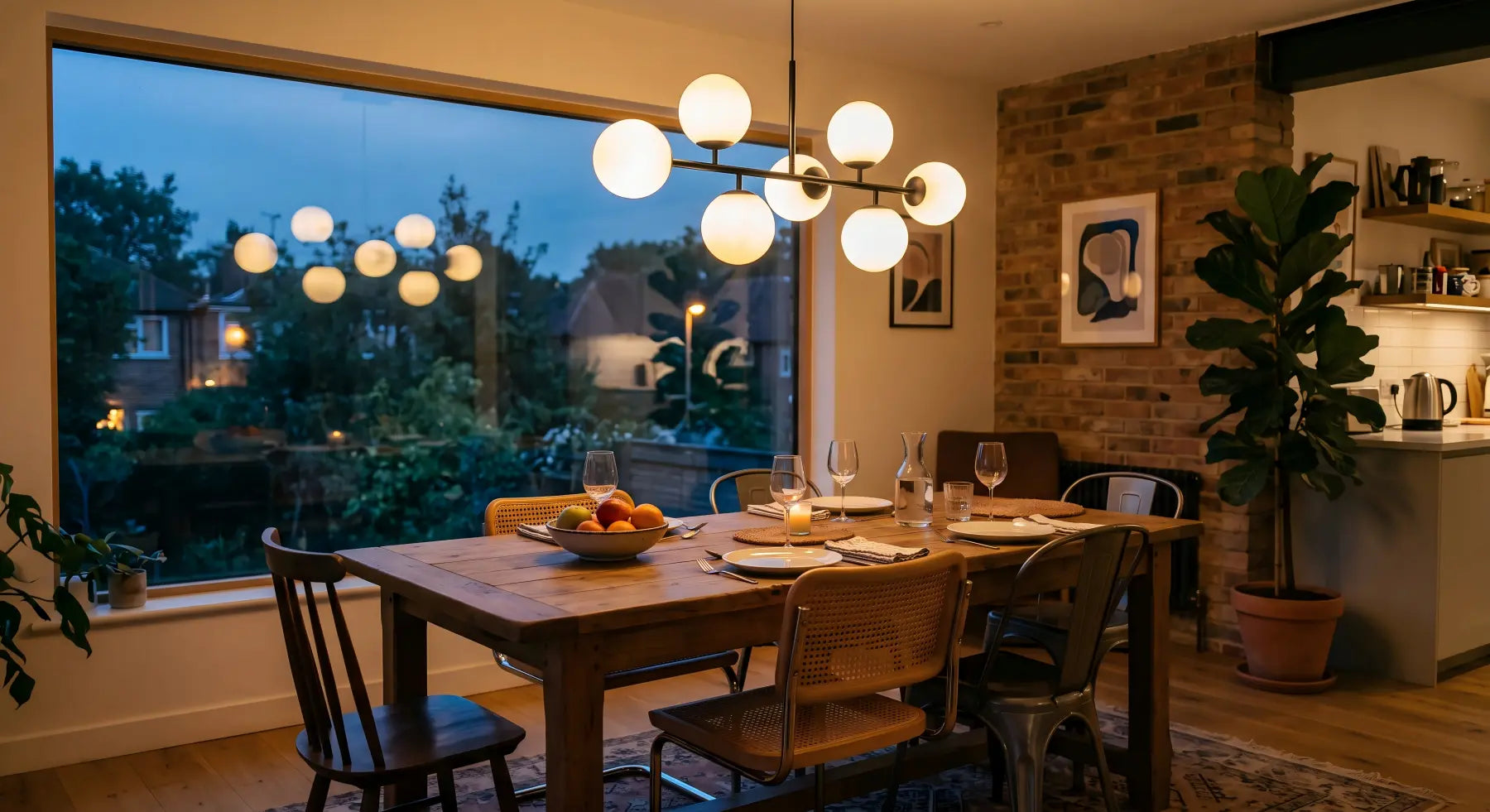

Walk into a model home at any new development in America — the kind with the professionally staged furniture and the fresh-baked-cookie smell — and look up. There's almost always a chandelier. Usually a large one. Usually in the first space you see.
That's not decorating. That's strategy.
Real estate professionals have known for decades that lighting is one of the most powerful tools for shaping how a buyer feels about a property. A well-lit home feels larger, cleaner, newer, and more valuable. And no single fixture delivers more perceived value per dollar spent than a chandelier in the right location.
This guide covers the real relationship between lighting upgrades and home value — which rooms give you the best return, how to light your home for an open house, and why Airbnb hosts are discovering that a $700 chandelier can pay for itself in months.
In This Guide
- The Psychology: Why Lighting Changes How Buyers Value a Home
- Which Rooms Give You the Best Lighting ROI?
- The Real Estate Agent Perspective
- How to Light Your Home for an Open House
- Airbnb & Short-Term Rental: How Lighting Pays for Itself
- How to Prioritize if You're on a Budget
- A Note on ROI Expectations
- For Design Professionals: Our Trade Program
- Frequently Asked Questions
The Psychology: Why Lighting Changes How Buyers Value a Home
Home buyers make emotional decisions and justify them with logic afterward. A buyer's gut impression forms within the first moments of entering a property. In those moments, the brain is processing space, light, smell, and proportion — and forming a feeling that's extremely difficult to reverse later in the tour.
Lighting affects every one of those first-impression signals:
- Perceived size. A well-lit room feels noticeably larger than the same room with flat, uniform overhead lighting. Layered light with a chandelier as the anchor creates depth, draws the eye upward, and makes ceilings feel taller.
- Perceived quality. A home with builder-grade flush-mount lights signals "basic." A home with a designed chandelier signals "someone cared about the details here." That perception bleeds into how buyers evaluate everything else — the countertops, the flooring, the finishes.
- Emotional warmth. Warm-toned light (2700K) triggers the same relaxation response as sunlight or candlelight. Buyers who feel relaxed and comfortable in a space are more likely to make an offer — and less likely to negotiate aggressively on price.
- Photography. In 2026, nearly every home search starts online. The listing photos are your property's first showing. Rooms with warm, well-designed lighting photograph dramatically better than rooms with flat overhead light. The chandelier becomes a visual anchor in the photo that makes the entire room look composed and intentional.
None of this is speculation. It's why professional staging companies keep chandeliers in their inventory as standard equipment — alongside throw pillows, fresh flowers, and white towels.
Which Rooms Give You the Best Lighting ROI?
Not every room benefits equally from a chandelier upgrade. Here's the priority ranking, based on how much perceived value each location adds relative to the cost of the fixture.
| Room | Investment Range | Perceived Value Impact | ROI Rating |
|---|---|---|---|
| Foyer / Entryway | $700–$1,500 | Sets the tone for the entire home. First and last thing buyers see. | ★★★★★ |
| Staircase | $800–$2,000 | Transforms a functional element into a design feature. Signals "grand." | ★★★★★ |
| Dining Room | $700–$1,300 | Signals "formal & well-maintained." Anchors the room's design. | ★★★★☆ |
| Kitchen Island | $400–$1,600 | Signals "updated & modern." The most-photographed area of the kitchen. | ★★★★☆ |
| Primary Bedroom | $500–$1,000 | Signals "luxury suite, not just a bedroom." Unexpected and memorable. | ★★★☆☆ |
Why the foyer ranks first
The entryway is disproportionately important because it anchors the buyer's entire experience. A builder-grade light in the foyer starts the tour on a flat note — every room after that has to overcome a "basic" first impression. A chandelier in the foyer does the opposite: it sets an expectation of quality that carries through the rest of the walkthrough. Buyers who are impressed at the front door tend to view the entire home more favorably.
For homes with 2-story foyers, this effect is amplified dramatically. A cascading chandelier filling that vertical space is often the single most memorable feature of the entire showing. It appears in every listing photo, and it's the detail buyers mention to their agent on the drive home.

The staircase: the most underrated location
Staircases occupy a unique architectural position — they're transitional spaces that buyers pass through but rarely think about. A well-placed cluster pendant in the stairwell transforms dead space into a design moment. The cascading silhouette follows the staircase line, creating visual drama at every step. For split-level and two-story homes, this is one of the highest-impact, lowest-competition upgrades you can make.
The Real Estate Agent Perspective: What Agents Actually Tell Sellers
Staging professionals and real estate agents across the US share remarkably consistent observations about lighting. While individual opinions vary, several themes come up again and again:
Lighting is the cheapest upgrade that makes a home "feel" more expensive. Compared to kitchen renovations ($15,000–$50,000), bathroom remodels ($10,000–$25,000), or new flooring ($5,000–$15,000), swapping lighting fixtures is a fraction of the cost with a disproportionate visual impact. A $2,000 total investment in three strategic chandeliers can shift a home's perceived quality tier in listing photos.
Builder-grade lights are the number-one "dated" signal. Those ubiquitous brass-and-frosted-glass flush mounts from the 1990s and 2000s immediately signal "never updated." Replacing them with modern fixtures is one of the fastest ways to make a home feel current without any structural work.
Warm light sells homes. Cool light doesn't. Agents consistently report that homes shown under warm (2700K) lighting feel more inviting during tours. Properties with cool fluorescent or high-temperature LED lighting receive more negative first impressions. Some agents even carry warm-temperature bulbs in their car to swap out before a showing.
The listing photo test. If a room doesn't photograph well, it doesn't sell well. Chandeliers give listing photos a natural focal point — the camera has something to anchor on, and the room reads as "designed" rather than "empty ceiling with a light."
How to Light Your Home for an Open House
If you're preparing for a showing or open house, these lighting strategies cost nothing extra but make a measurable difference in how buyers experience the space.
Rule 1: Turn everything on — including during daytime showings
Natural daylight is wonderful, but relying on it alone creates contrast problems. The window side of the room glows while the opposite wall falls into shadow. Turning on your chandelier and supplementary lights during the day fills those shadows, creates warmth throughout the space, and makes the room feel finished rather than dependent on time-of-day.
Rule 2: Dim to 75–80%, not 100%
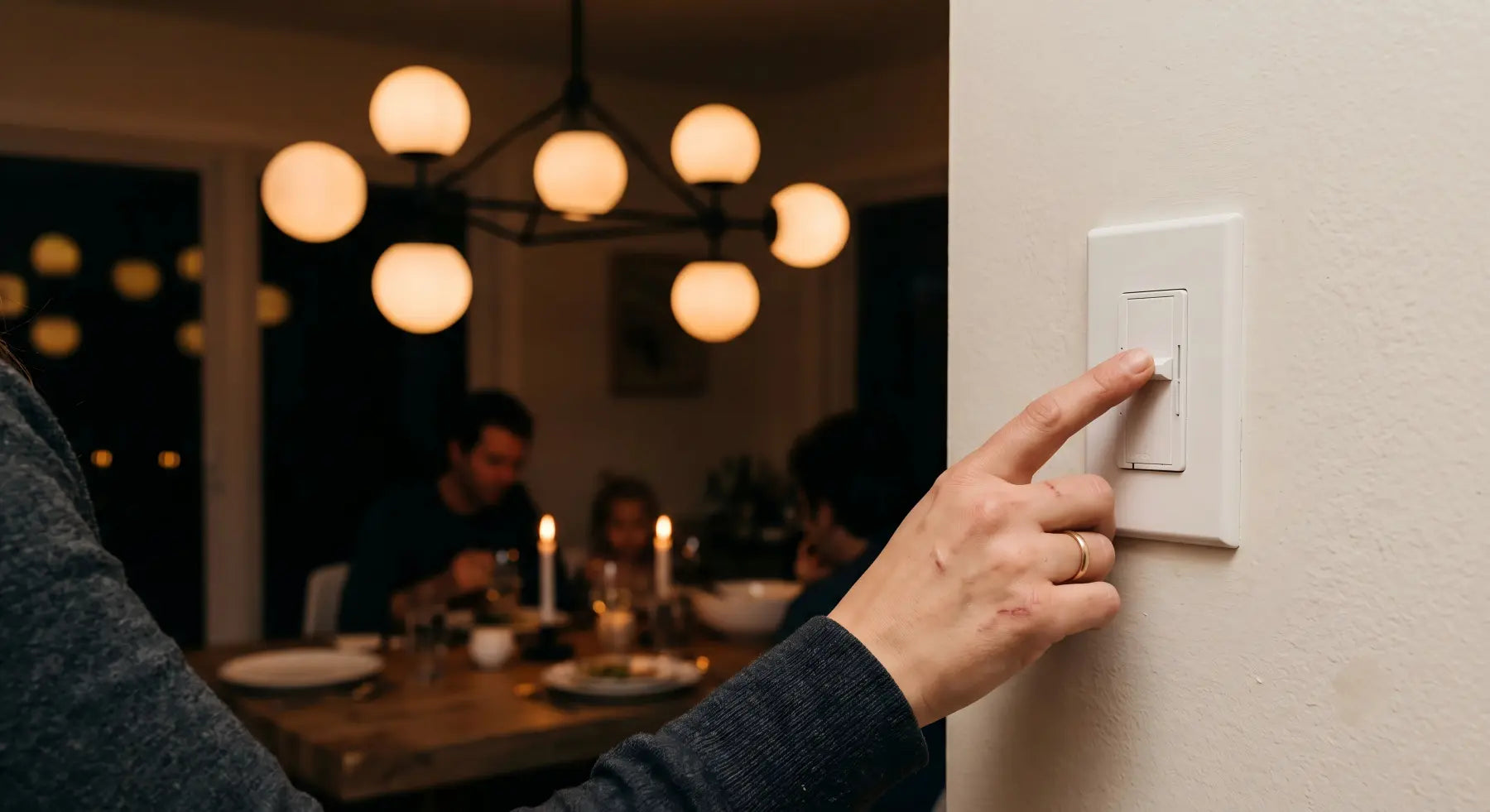
Full brightness is for task work — cooking, reading, cleaning. For a showing, you want ambiance, not a spotlight. Dimming to 75–80% creates a warm, golden atmosphere that flatters the space and the people walking through it. At 100%, light can feel harsh, expose every minor flaw, and create the opposite of the welcoming feeling you want.
This is where dimmable chandeliers earn their investment. Every Aurorae Lighting fixture is dimmable and compatible with Lutron Diva and Caséta dimmers, so dialing in the perfect showing atmosphere takes seconds.
Rule 3: Stage the dining table under the chandelier
An empty dining room with a chandelier is good. A dining table set with simple place settings under a dimmed chandelier is great. The table gives the room purpose, and the chandelier gives it romance. You don't need fine china — white plates, simple glasses, and a low centerpiece are enough. The chandelier does the heavy lifting.

Rule 4: Light the path
The buyer's journey through your home is a sequence of lighting moments. Foyer chandelier → hallway sconces → dining room chandelier → kitchen island pendants → staircase pendant. Each fixture should be on and set to a warm, inviting level. If there's a dark gap in the sequence (a dim hallway, an unlit corner), it breaks the spell.
Rule 5: Clean the fixtures before every showing
Dusty chandeliers read as neglected, even if the rest of the house is spotless. A quick wipe with a dry microfiber cloth the morning of a showing takes five minutes and makes a real difference. Clean glass = brighter light = better impression.
Airbnb & Short-Term Rental: How Lighting Pays for Itself
Short-term rental hosts operate in one of the most visually competitive markets on earth. Guests scroll through dozens of listings in seconds. Your photos have less than two seconds to stop the thumb.

Lighting plays an outsized role in Airbnb success for three specific reasons:
1. Better photos = higher click-through rate
Airbnb's algorithm rewards listings with higher click-through rates by showing them to more potential guests. Professional-looking photos with warm, designed lighting get more clicks than photos of rooms with flat overhead light. A chandelier creates a focal point in the photo that makes the space look curated and intentional — like a boutique hotel, not a rental unit.
2. Higher perceived quality = higher nightly rate
Guests use visual cues to judge whether a listing is worth $150/night or $250/night. A well-chosen chandelier in the living area or bedroom shifts the property from "nice apartment" to "design-forward retreat." For a property earning 200+ nights per year, even a $15/night rate increase from a perceived quality upgrade generates $3,000+ in additional annual revenue — paying for the fixture many times over.
3. Better reviews mention lighting specifically
Hosts who invest in designed lighting frequently receive reviews mentioning the ambiance: "the lighting was so warm and inviting," "the living room felt like a luxury hotel," "loved the chandelier in the dining area." These comments in reviews attract future guests who value similar qualities — creating a positive feedback loop of higher-quality bookings.
Best fixtures for Airbnb properties
Short-term rentals have specific requirements that differ from owner-occupied homes:
- Durability matters. Guests aren't as careful as homeowners. Choose fixtures with sturdy construction and materials that resist fingerprints and casual contact. Opal glass is ideal — the smooth, non-porous surface wipes clean easily and doesn't show smudges the way crystal does.
- Maintenance should be minimal. You (or your cleaning team) shouldn't need to spend 20 minutes polishing a chandelier between turnovers. Opal and frosted glass chandeliers need only a quick dry cloth wipe — no special cleaners, no disassembly.
- Simple bulb maintenance matters. Fixtures with replaceable bulbs keep long-term upkeep down to a quick, inexpensive bulb swap rather than servicing the whole fixture. Most Aurorae chandeliers use replaceable E14, G4, G9, or E26 bulbs — check the bulb type on each product page when choosing fixtures for a rental.
- Visual impact in photos is the priority. Choose fixtures that photograph well — warm light, interesting silhouettes, and enough scale to be clearly visible in a wide-angle listing photo. The Cascading Textured Glass Chandelier ($1,299+) is particularly photogenic because the textured glass creates interesting light patterns that camera sensors love.
How to Prioritize if You're on a Budget
If you can only upgrade one or two fixtures before listing or launching your rental, here's the priority order based on maximum impact per dollar:
Budget: One fixture ($700–$1,300)
Upgrade the foyer/entryway. This is the single highest-impact swap. Replace the builder-grade flush mount with a chandelier that fills the space vertically. For standard 8–9 foot ceilings, the Opal Glass 5-Light Chandelier ($699) delivers a modern, warm statement at an accessible price point. For taller foyers, the Multi-Arm Opal Glass Chandelier ($899+) fills more vertical space with its dramatic arm design.
Budget: Two fixtures ($1,200–$2,200)
Foyer + dining room. These are the two rooms that every buyer and every listing photo focuses on. The foyer sets the first impression; the dining room confirms it. Choose fixtures from the same material family (both glass, or both crystal) in complementary but not identical designs. For example: Opal Glass Globe in the foyer + Luminous Waves Chandelier ($997+) in the dining room — both are glass and warm-toned, but each has a distinct personality.
Budget: Three fixtures ($2,000–$3,500)
Foyer + dining room + kitchen island. This covers the three spaces that drive the most buyer attention. The kitchen island is the modern American home's social hub — pendant lighting there signals "this kitchen has been thoughtfully designed." Add the Pebbles Pendant ($219+) over the island for an organic glass accent that ties into the glass chandeliers in the other rooms.
A Note on ROI Expectations
Let's be honest: no one can guarantee that a chandelier will increase your home's appraised value by a specific dollar amount. Appraisals are based on comparable sales, not light fixtures. And no buyer has ever paid $5,000 more for a house solely because of the chandelier in the foyer.
What lighting does do — and what staging professionals consistently observe — is influence the speed and emotional certainty of the purchase decision. A home that feels warm, designed, and move-in-ready generates offers faster. A home that generates multiple offers creates competitive bidding. And competitive bidding is where real financial returns happen.
The chandelier doesn't add value on a spreadsheet. It adds value in the gut of the buyer standing in your foyer, looking up, and thinking: "This feels like home."
For Design Professionals: Our Trade Program
If you're a real estate stager or interior designer who regularly specifies lighting for client projects, our Trade Program offers:
- Trade pricing across our online collection
- Project quotes for multi-fixture orders
- 3D renderings on request for project orders — visualize fixtures in a client's space before committing to an order
Learn more about the Trade Program or email us directly at info@auroraelighting.com.
Frequently Asked Questions
Do chandeliers increase home value?
Chandeliers don't directly increase appraised value by a specific dollar amount, but they significantly influence buyer perception, emotional response, and the speed of purchase decisions. Staging professionals consistently report that well-chosen lighting — particularly in foyers, dining rooms, and staircases — makes homes feel more expensive, generate offers faster, and create more competitive bidding situations. A $700–$2,000 lighting investment is one of the most cost-effective upgrades for perceived home value.
What is the best lighting for staging a home for sale?
Use warm white lighting (2700K) with CRI 90+ throughout the home. Turn all fixtures on during showings, even during daytime, and dim chandeliers to 75–80% for ambiance rather than full brightness. Prioritize the foyer (first impression), dining room (formal anchor), and kitchen island (modern upgrade signal). Stage the dining table with simple place settings under the chandelier, and clean all fixtures before every showing.
Which room should I upgrade lighting in first before selling?
The foyer or entryway should be your first priority. It's the first and last space buyers experience, and it sets the emotional tone for the entire tour. A builder-grade flush mount replaced with a modern chandelier is the single highest-impact lighting upgrade for home sales. If you have budget for a second fixture, add the dining room. For a third, add kitchen island pendants.
Can a chandelier increase Airbnb rental income?
Yes. Well-designed lighting improves listing photos, which increases click-through rates and bookings. It also enables higher nightly rates by elevating perceived quality from "nice apartment" to "design-forward retreat." A $15/night increase on a property earning 200+ nights per year generates $3,000+ in additional annual revenue — paying for the fixture investment multiple times over. Guest reviews frequently mention warm, inviting lighting as a highlight.
What chandelier is best for an Airbnb rental property?
Choose fixtures that are durable, easy to clean, and photograph well. Opal and frosted glass chandeliers are ideal because the smooth surface wipes clean with a dry cloth between turnovers, unlike crystal which requires more maintenance. Fixtures with replaceable bulbs keep long-term maintenance simple — most Aurorae chandeliers use replaceable E14, G4, G9, or E26 bulbs (check each product page for the bulb type). Warm 2700K light and interesting silhouettes that read well in wide-angle listing photos should be priorities.
Should I leave chandeliers when selling my house?
In most US real estate transactions, permanently installed light fixtures are considered part of the property and convey with the sale by default. If you plan to take a chandelier with you, specify it as an exclusion in the listing and replace it with a comparable fixture before showings. Removing a chandelier and leaving an empty junction box creates a negative impression that can offset any savings.