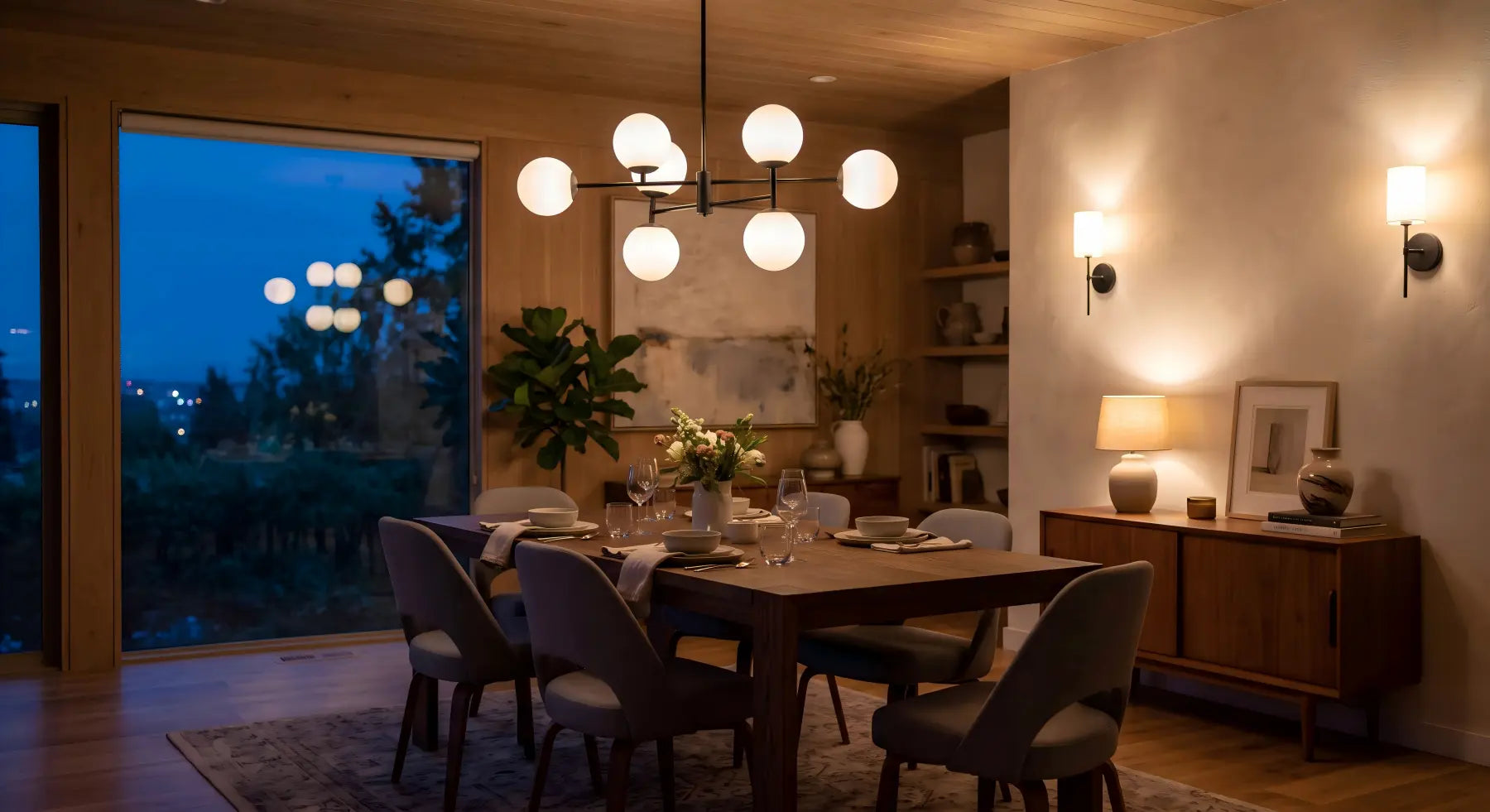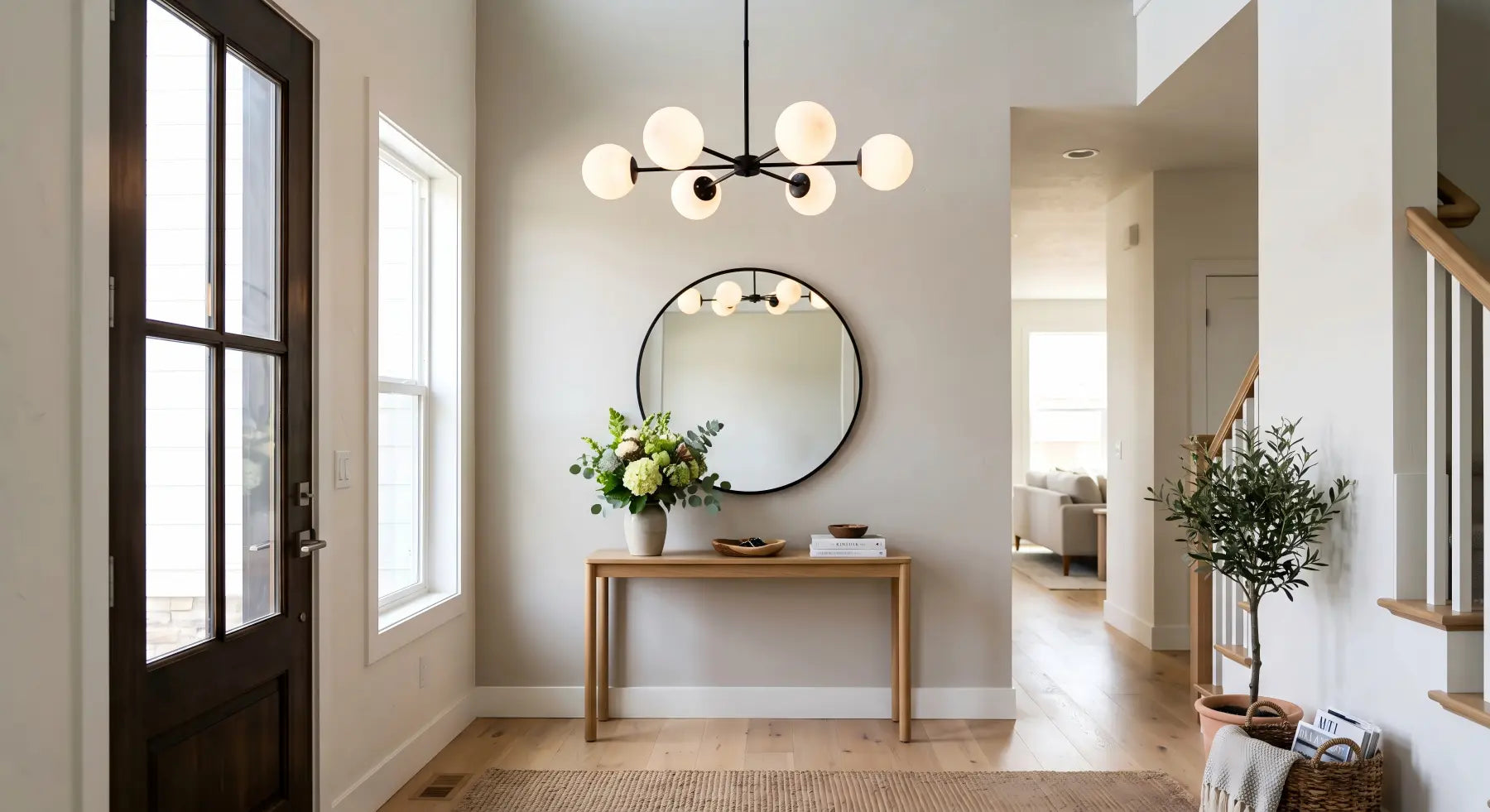

Here's a number that surprises almost everyone: our 5-light Opal Glass Globe Chandelier uses 15 watts total. That's the entire fixture — all five bulbs combined.
To put that in perspective: a single old-fashioned 60-watt incandescent bulb uses four times more electricity than our entire 5-light chandelier. A traditional 5-light incandescent chandelier at 60 watts per bulb would draw 300 watts — twenty times more power.
If electricity costs feel abstract, let's make them concrete. This guide compares the real costs of running LED versus incandescent chandeliers over 1, 5, and 10 years — including the hidden expense most people forget: replacement bulbs.
In This Guide
- The Basic Math: LED vs Incandescent Electricity Cost
- The Cost People Forget: Replacement Bulbs
- Total Cost of Ownership: The 10-Year Picture
- Don't LED Chandeliers Produce Less Light?
- Real Energy Numbers Across the Aurorae Collection
- The Environmental Angle: Carbon Footprint
- What About Dimming?
- A Realistic Comparison: The 3-Chandelier Home
- The Quality Question
- Your Home's Energy Savings, Calculated
- Frequently Asked Questions
The Basic Math: LED vs Incandescent Electricity Cost
Let's use a simple, consistent scenario: a chandelier running 5 hours per day (a typical evening pattern — on at 5pm, off at 10pm), at the US national average electricity rate of $0.16 per kilowatt-hour.
| Fixture | Total Wattage | Annual Cost | 5-Year Cost | 10-Year Cost |
|---|---|---|---|---|
| Incandescent 5-light (60W bulbs) | 300W | $87.60 | $438.00 | $876.00 |
| Halogen 5-light (40W bulbs) | 200W | $58.40 | $292.00 | $584.00 |
| Aurorae LED 5-light (3W bulbs) | 15W | $4.38 | $21.90 | $43.80 |
| Aurorae LED 7-light (3W bulbs) | 21W | $6.13 | $30.66 | $61.32 |
| Aurorae LED 10-light (3W bulbs) | 30W | $8.76 | $43.80 | $87.60 |
The formula, if you want to check the math: Wattage × 5 hours/day × 365 days ÷ 1,000 × $0.16/kWh = annual cost.
Read that last row again: the 10-light configuration costs $8.76 per year in electricity. That's less than a single month of a streaming subscription. And it costs less to run for an entire year than a traditional 5-light incandescent chandelier costs to run for six weeks.
Even a large statement piece in our catalog — the 36-light Multi-Arm Opal Glass Chandelier at 108W — runs about $31.54 per year, still about a third of what a single 5-light incandescent fixture costs.
The Cost People Forget: Replacement Bulbs
Electricity is only half the story. The other half is how often you're climbing a ladder to change burned-out bulbs — and how much those bulbs cost over time.
| Bulb Type | Typical Rated Lifespan | At 5hrs/day | Cost per Bulb | 10-Year Bulb Cost (5-light) |
|---|---|---|---|---|
| Incandescent (E14/E12) | 1,000 hours | ~7 months | $2–$4 | $180–$365 |
| Halogen | 2,000 hours | ~13 months | $3–$5 | $135–$230 |
| LED (Aurorae included) | 15,000–50,000 hours | 8–27 years | $3–$5 | $0–$25 |
An incandescent bulb in a chandelier running 5 hours daily burns out roughly every 7 months. In a 5-light fixture, that means you're replacing bulbs about 9 times per year — and buying roughly 90 bulbs over a decade. At $2–$4 per specialty candelabra bulb, that adds $180–$365 to the true cost of ownership.
LED bulbs of the class used in modern chandeliers are typically rated between 15,000 and 50,000 hours. Even at the conservative end, that's more than 8 years of daily 5-hour use before the first bulb change — and at the higher ratings, the bulbs that ship with your fixture may be the only bulbs you ever need. Over a 10-year window, your total bulb cost is somewhere between zero and one inexpensive replacement round. Compare that to a ladder climb every few weeks with incandescents.
Total Cost of Ownership: The 10-Year Picture
Now let's add it all together — electricity plus bulb replacements over 10 years for a 5-light chandelier:
| Incandescent | Halogen | Aurorae LED | |
|---|---|---|---|
| 10-year electricity | $876 | $584 | $44 |
| 10-year bulb replacements | $180–$365 | $135–$230 | $0–$25 |
| Total 10-year operating cost | $1,056–$1,241 | $719–$814 | $44–$69 |
| Savings vs incandescent | — | — | $987–$1,197 |
Over 10 years, a single Aurorae LED chandelier saves you roughly $1,000 in operating costs compared to running a traditional incandescent chandelier. If you have three chandeliers in your home (foyer, dining room, and staircase), that's approximately $3,000 in savings over a decade — a meaningful chunk of what the fixtures themselves cost.
But Wait — Don't LED Chandeliers Produce Less Light?
This is the most common misconception about LED lighting, and it's completely understandable. For decades, we measured light output by watts — "a 60-watt bulb is bright, a 40-watt is dimmer." But watts measure energy consumption, not light output.
Light output is measured in lumens. And this is where modern LEDs have a massive advantage:
| Technology | Efficiency | To produce 800 lumens (equivalent to old 60W bulb) |
|---|---|---|
| Incandescent | ~15 lumens/watt | Needs ~55–60W |
| Halogen | ~20 lumens/watt | Needs ~40W |
| CFL (compact fluorescent) | ~60 lumens/watt | Needs ~13W |
| Modern LED (Aurorae: 115–120 LM/W) | ~100–130 lumens/watt | Needs only ~7W |
Aurorae chandeliers with E14, G4, G9, or integrated LEDs deliver 115–120 lumens per watt — meaning each 3-watt LED bulb produces roughly the same visible light as a 25-watt incandescent candelabra bulb, but using 88% less electricity. The light isn't dimmer. It's just dramatically more efficient at converting electricity into photons instead of waste heat.

Speaking of heat: incandescent bulbs convert about 90% of their energy into heat and only 10% into visible light. That's why they burn your fingers and make rooms warmer in summer. LEDs typically run cool to the touch — your chandelier won't heat up your dining room in July or become a hazard when you're adjusting the hanging height.
Real Energy Numbers Across the Aurorae Collection
Here's the energy profile for a representative range of fixtures across our Chandelier and Pendant Light collections, calculated at 5 hours/day and $0.16/kWh:
| Fixture | Total Wattage | Annual Cost | Equivalent To |
|---|---|---|---|
| Opal Glass 5-Light | 15W | $4.38 | One table lamp |
| Opal Glass 7-Light | 21W | $6.13 | A phone charger running all day |
| Opal Glass 10-Light | 30W | $8.76 | A laptop in use |
| Half-Ring LED Chandelier (16-Light) | 48W | $14.02 | A ceiling fan on medium |
| Pebbles Pendant 3-Light | 15W | $4.38 | One table lamp |
| Cubes Pendant | 18–30W | $5.26–$8.76 | A desktop monitor |
The "Equivalent To" column puts these numbers in perspective. Your Opal Glass 5-Light chandelier — a fixture that illuminates an entire dining room with warm, beautiful light — draws the same power as a single bedside table lamp. Your energy bill genuinely will not notice it.
The Environmental Angle: Carbon Footprint of Your Chandelier
If sustainability matters to you, here's what the energy savings translate to in environmental terms.
The US average carbon intensity of electricity is approximately 0.85 lbs of CO₂ per kWh. Using our 5-light Opal Glass Chandelier as the example:
- Aurorae LED 5-light: 15W × 5hrs × 365 days = 27.4 kWh/year → 23 lbs CO₂/year
- Incandescent 5-light: 300W × 5hrs × 365 days = 547.5 kWh/year → 465 lbs CO₂/year
- Annual CO₂ reduction by choosing LED: 442 lbs — equivalent to driving about 500 fewer miles per year, or planting about 3 tree seedlings annually.
Over 10 years, a single LED chandelier prevents approximately 4,400 lbs of CO₂ from entering the atmosphere compared to running an incandescent fixture. For a household with three LED chandeliers, that's over 13,000 lbs of CO₂ — roughly the same as taking a car off the road for an entire year.
These aren't hypothetical numbers. This is the actual emissions reduction from choosing one technology over another for a fixture you're going to run every evening regardless.
What About Dimming? Does It Save Even More Energy?
Yes — and the savings are proportional. When you dim an LED chandelier to 50%, it draws roughly 50% of the power. (Incandescent dimmers are less efficient — dimming to 50% brightness only reduces power by about 25–35%, because the filament still needs to stay hot.)
If you typically run your dining room chandelier at 60–70% brightness for everyday meals (a common and aesthetically superior setting), the real-world annual cost for the Opal Glass 5-Light drops from $4.38 to approximately $2.63–$3.07 per year.
This is another advantage of dimmable LED chandeliers with compatible dimmers. You're not just getting better ambiance — you're getting even lower operating costs. The dollar savings from dimming are modest (LED costs are already tiny), but they come bundled with dramatically better atmosphere, which is the real reason to install a dimmer.
A Realistic Comparison: The 3-Chandelier Home
Most homes that invest in designed lighting end up with 2–3 chandeliers or statement pendants. Let's look at a realistic scenario: foyer + dining room + kitchen island, comparing a fully incandescent setup against a fully LED setup, light for light.
| Location | Incandescent Setup | Aurorae LED Setup |
|---|---|---|
| Foyer (8-light) | 480W → $140.16/yr | Multi-Arm Opal 24W → $7.01/yr |
| Dining Room (7-light) | 420W → $122.64/yr | Opal Glass 7-Light 21W → $6.13/yr |
| Kitchen Island (3-light) | 180W → $52.56/yr | Pebbles Pendant 15W → $4.38/yr |
| Total Annual | $315.36/yr | $17.52/yr |
| Total 10-Year (electricity only) | $3,154 | $175 |
| 10-Year Savings | LED saves $2,978 in electricity alone | |
Add another $660–$1,310 in avoided bulb replacements over 10 years (that's 18 incandescent sockets burning through roughly 330 bulbs), and the total savings for a 3-fixture LED home approaches $3,500–$4,300 compared to running incandescent fixtures.
That's not a rounding error. That's a vacation.
The Quality Question: Do LED Chandeliers Look as Good as Incandescent?
This used to be a legitimate concern. Early LED bulbs (2010–2015 era) produced cold, flickery, unflattering light that made rooms feel like medical offices. The technology has improved dramatically since then.

Modern LEDs — specifically the ones in Aurorae chandeliers — deliver:
- Warm white light (2700K–3000K depending on the model, with a 6000K cool white option on select designs) — comparable to incandescent warmth. The golden glow that makes rooms feel inviting and people look their best. If you didn't know the fixture was LED, you would be unlikely to guess from the light quality alone.
- CRI >90 — color rendering accuracy that rivals natural daylight. Food looks appetizing. Skin tones glow. Art and textiles reveal their true colors. Learn more about CRI and color temperature.
- Flicker-free operation — no strobing or pulsing at any brightness level. Smooth, steady light from 100% down to 10% when used with a compatible Lutron dimmer.
- Instant on — full brightness the moment you flip the switch. No warm-up period (unlike older CFL bulbs that took 30–60 seconds to reach full output).
The visual quality gap between LED and incandescent has effectively closed. What remains is a massive gap in efficiency, longevity, and operating cost — all in LED's favor.
Your Home's Energy Savings, Calculated
Want to calculate the exact savings for your specific situation? Here's the formula:
Annual electricity cost = Total fixture wattage × daily hours × 365 ÷ 1,000 × your local $/kWh rate
Find your electricity rate on your utility bill (look for the "price per kWh" line) and plug in the wattage from any Aurorae product page specifications table. The math takes 30 seconds and the results will probably make you smile.
If you're replacing existing incandescent fixtures, calculate the difference between your current setup's wattage and the Aurorae LED wattage. That gap — multiplied by hours, days, and your rate — is money that stays in your pocket every month, every year, for the life of the fixture.
Frequently Asked Questions
How much electricity does an LED chandelier use?
Modern LED chandeliers use very little electricity. A typical 5-light LED chandelier uses 15 watts total — about the same as a single table lamp. At average US electricity rates ($0.16/kWh) running 5 hours daily, that's approximately $4–5 per year. A comparable 5-light incandescent chandelier at 300 watts would cost about $88 per year — roughly 20 times more.
How much money does an LED chandelier save compared to incandescent?
Over 10 years, a single 5-light LED chandelier saves roughly $1,000 compared to an incandescent fixture — about $832 in electricity plus $180–$365 in avoided bulb purchases. For a home with three LED chandeliers and pendants, the 10-year savings approaches $3,500–$4,300 including both electricity and bulbs.
How long do LED chandelier bulbs last?
LED bulbs of the class used in chandeliers are typically rated between 15,000 and 50,000 hours depending on the specific bulb. At 5 hours of daily use, that's roughly 8 to 27 years. By comparison, incandescent chandelier bulbs last about 1,000 hours (around 7 months at 5 hours/day) and halogen bulbs about 2,000 hours (just over a year). Even at the conservative end of LED ratings, you're looking at nearly a decade of use before the first bulb change.
Are LED chandeliers as warm and bright as incandescent?
Yes. Modern LED chandeliers with warm white color temperatures (2700K–3000K) produce the same golden glow as incandescent bulbs. The visual quality gap has effectively closed. High-quality LED fixtures with CRI above 90 render colors nearly as accurately as natural daylight. The remaining differences are all in LED's favor: up to 95% less energy use, minimal heat (cool to the touch), instant full brightness, and dramatically longer bulb life.
Does dimming an LED chandelier save energy?
Yes, and the savings are proportional. Dimming an LED chandelier to 50% brightness reduces power consumption by approximately 50%. If you typically run a dining room chandelier at 60–70% brightness for everyday use, annual energy costs drop even further. This is more efficient than incandescent dimming, where reducing brightness to 50% only cuts power by 25–35% because the filament must remain heated.