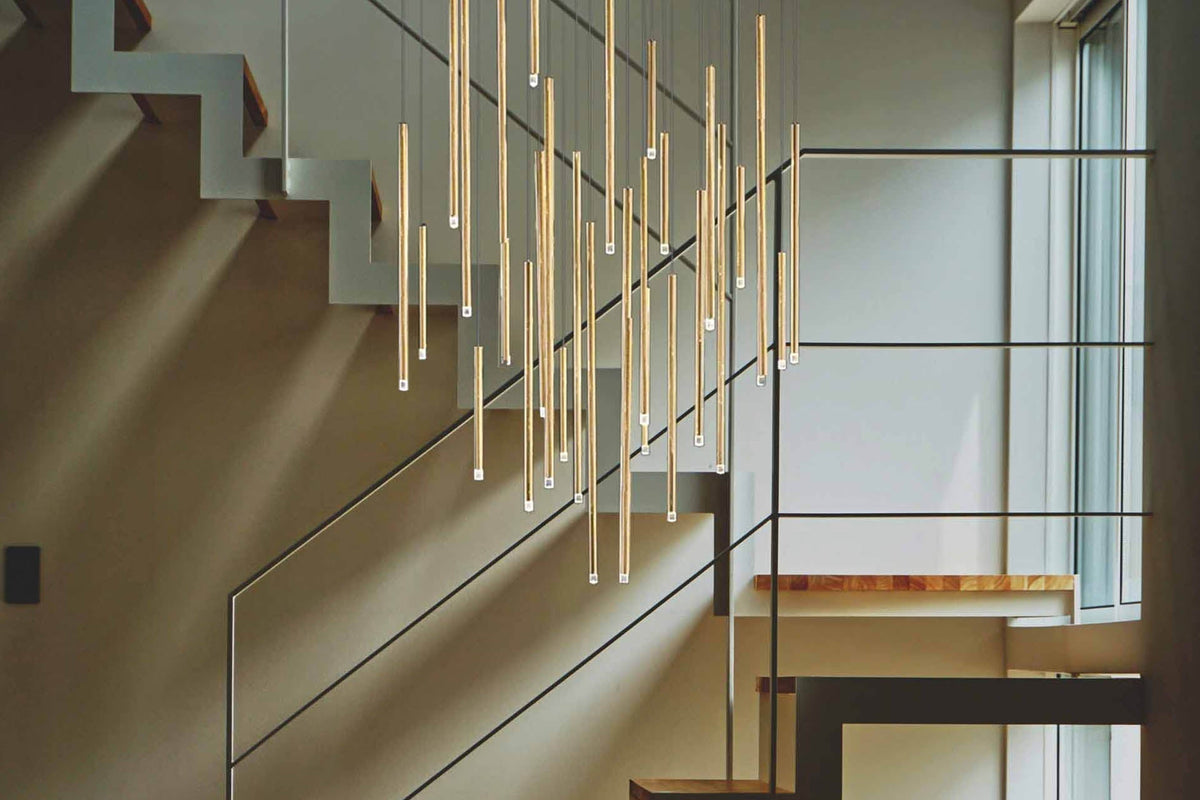

A staircase is the one space in your home where you experience lighting vertically — looking up as you enter, looking across as you climb, and looking down from the landing above. The right chandelier transforms this transitional space from a dark corridor into an architectural feature.
But staircase lighting has unique requirements. The fixture hangs in a tall, narrow column of air. It's viewed from multiple levels and angles. It has to be able to hang far enough below a high ceiling to reach the correct position. And it needs to look good from 360 degrees, not just from the front.
Here are five staircase chandelier styles that solve all of these challenges — organized by design direction so you can find the approach that matches your home.
1. Organic Glass Cluster — The Modern Classic
Glass Pebbles Cluster Chandelier

Hand-blown glass pebbles suspended at staggered heights from a single canopy. The organic shapes catch light differently from every angle — essential in a stairwell where the viewing perspective changes with every step. The staggered drops naturally fill the vertical space without looking forced.
Best for: Contemporary and transitional homes, open stairwells with 12–20 foot ceilings. The glass forms soften angular architecture and add warmth to spaces dominated by wood, stone, or metal railings. Adjustable height reaches up to 177 inches in the 36-light configuration.
Why it works in a staircase:
- Pebble-shaped shades have no "front" or "back" — they look beautiful from every level
- Staggered heights create a cascading constellation that follows the stair line
- Frosted and textured glass diffuses light evenly, avoiding harsh hotspots on the stairs below
2. Prismatic Crystal — Timeless Elegance

K9 crystal elements arranged in a vertical column that refracts light throughout the stairwell. Crystal chandeliers have been the traditional choice for grand staircases for centuries — the 2026 version pairs that same sparkle with LED technology, reducing the heat and bulb-changing hassle of older crystal fixtures.
Best for: Colonial, traditional, and luxury homes with formal staircases. The crystal creates dancing light patterns on walls that change throughout the day as natural light shifts — a living display that makes the staircase feel dynamic. Adjustable height reaches up to 196.8 inches in the 40-light configuration.
Why it works in a staircase:
- Crystal refracts light in every direction, filling tall stairwells with scattered brilliance
- The vertical form draws the eye upward through the full height of the space
- Pairs naturally with traditional banisters, wood trim, and formal architecture
3. Opal Glass Globe — Warm and Versatile
Modern Opal Glass Globe Chandelier

Milky opal glass globes that glow like warm moons at different heights. The frosted glass reduces glare — important in a staircase where you're often looking directly at the fixture from below. Available in multiple configurations (5, 7, or 10 lights) with both round and rectangle canopy, so you can scale the fixture to match your specific stairwell dimensions.
Best for: Any home style from modern to transitional. The opal globe is one of the most universally compatible chandelier forms — it doesn't commit to a specific aesthetic, which makes it the safest choice if you're unsure about style direction.
Why it works in a staircase:
- Diffused opal glass means minimal glare when looking up from the bottom of the stairs
- Multiple size options (5 to 10 lights) scale to stairwells of different heights
- The 10-light configuration adjusts up to 177 inches, enough for ceilings up to about 21 feet
4. Sculptural Arms — Dynamic Silhouette
Black Arm Opal Glass Chandelier

Articulated metal arms hold frosted glass shades in an expressive, almost kinetic arrangement. It suits staircases where the chandelier needs to be more than a light source — it needs to be a sculptural focal point visible from the front door.
Best for: Homes where the staircase is visible from the entryway and the chandelier serves double duty as a foyer statement piece and staircase illumination. The dramatic arm structure creates visual complexity that holds attention from long viewing distances. Adjustable height reaches 368 inches in the largest configuration — our longest staircase fixture.
Why it works in a staircase:
- Arm structure creates depth and dimension — more visually engaging than a simple drop cluster
- Available in multiple configurations to fit stairwells from 10 to 20+ feet
- Frosted opal shades reduce glare while the black metal arms add architectural definition
5. Artisanal Crystal Spheres — Light Within Light
Artisanal Crystal Sphere Chandelier

Hand-cast K9 crystal spheres hang from a polished chrome frame in a spiral or random drop. In a stairwell, the cascade of glowing crystal fills the vertical space and scatters light across the walls — visible from the entry, the stairs, and the landing above.
Best for: Modern and transitional homes that want crystal sparkle without an ornate traditional frame. The 36- and 46-light sizes suit two-story stairwells, and the 46-light configuration reaches up to 177 inches. Both weigh more than 50 lbs, so they need a fan-rated ceiling brace.
Why it works in a staircase:
- Spheres drop at staggered heights, filling the vertical space of a stairwell
- Reads well from below, from the stairs, and from the landing above
- Available in 2700K warm white or 6000K cool white
Quick Comparison: Which Style Is Right for You?
| Style | Best Home Style | Max Adjustable Height | Starting From |
|---|---|---|---|
| Glass Pebbles Cluster | Contemporary, transitional | 177" (36-light) | $4,032 |
| Chrome Crystal LED | Traditional, luxury, colonial | 196.8" (40-light) | $1,085 |
| Opal Glass Globe | Any — universally compatible | 177" (10-light) | $699 |
| Black Arm Opal Glass | Statement foyers, entryway-visible stairs | 368" (36-light) | $899 |
| Artisanal Crystal Sphere | Modern, minimalist | 177" (46-light) | $885 |
Staircase Chandelier Sizing Tips
Getting the right size and height is critical in a stairwell — mistakes are amplified by the tall, narrow space. Here are the key rules:
Fixture body height: Multiply your ceiling height (feet) × 2.5 to 3 = ideal fixture body height (inches). A 16-foot stairwell calls for a fixture body of 40–48 inches.
Hanging position: The center of the fixture body should align approximately with the second-floor landing or railing level. The bottom should never hang lower than 7 feet above any stair tread.
Total drop: Measure the distance you need from the ceiling down to the bottom of the fixture: ceiling height minus your target bottom height. In a 2-story stairwell the bottom usually sits 8–10 feet above the floor (never less than 7 feet above any tread), so a 16-foot ceiling needs roughly 72–108 inches of drop and a 20-foot ceiling roughly 120–156 inches. Many standard fixtures max out at 60–72 inches — not enough for most 2-story stairwells. Maximum adjustable heights for the five fixtures above:
- Black Arm Opal Glass: up to 368 inches (36-light) — our longest
- Chrome Crystal LED: up to 196.8 inches (40-light)
- Glass Pebbles Cluster: up to 177 inches (36-light)
- Opal Glass Globe: up to 177 inches (10-light)
- Artisanal Crystal Sphere: up to 177 inches (46-light)
Smaller configurations of the same fixture have shorter maximum heights — always check the product page for your chosen configuration before ordering.
For the complete room-by-room sizing and height guide, see How High to Hang a Chandelier and Best Chandeliers for 2-Story Foyers & High Ceilings.
Browse More Staircase Lighting
See our full Staircase & Stairwell Chandeliers collection for all available styles and configurations. Every fixture includes dimmable LEDs (CRI >90), and a sloped-ceiling adapter is provided at no extra cost once an angled ceiling is confirmed. Color temperature is 2700K or 3000K warm white depending on the model, and the Artisanal Crystal Sphere is also available in 6000K cool white. UL Listed for US & Canada, CE certified for European markets. Backed by our 4-year warranty.
Not sure which style fits your staircase? Email us a photo of your stairwell with the ceiling height and we'll recommend specific fixtures for your space.
Frequently Asked Questions
What chandelier is best for a staircase?
The best staircase chandelier depends on your ceiling height, home style, and how visible the fixture is from the entryway. For modern homes, organic glass cluster pendants or crystal sphere chandeliers work well. For traditional homes, prismatic crystal chandeliers are a classic choice. For maximum reach and visual drama, multi-arm opal glass chandeliers adjust up to 368 inches — the longest option for 3-story stairwells. A widely compatible choice is an opal glass globe chandelier, which suits most architectural styles.
How much drop does a staircase chandelier need?
Work out the total drop — the distance from the ceiling to the bottom of the fixture — by subtracting your target bottom height from the ceiling height. In a 2-story stairwell the bottom usually sits 8–10 feet above the floor, so a 16-foot ceiling needs roughly 72–108 inches of drop, an 18-foot ceiling roughly 96–132 inches, and a 20-foot ceiling roughly 120–156 inches. Many standard chandeliers max out at 60–72 inches, which is not enough for tall stairwells. For 3-story stairwells, look for fixtures that adjust to 177 inches or more; the largest Black Arm Opal Glass configuration reaches 368 inches.
How high should a staircase chandelier hang?
The center of a staircase chandelier should align approximately with the second-floor landing or railing level. The bottom of the fixture should never hang lower than 7 feet above any stair tread — measured at the point where the fixture is closest to the stairs. For fixture body height, multiply your ceiling height in feet by 2.5 to 3 to get the ideal fixture body height in inches. A 16-foot stairwell calls for a fixture body of roughly 40–48 inches tall.
What size chandelier do I need for a 2-story staircase?
For a standard 2-story staircase with a 16–18 foot ceiling, choose a chandelier with a body height of 40–54 inches and a diameter of 20–30 inches. The fixture should be visible from both the ground floor and the upper landing without blocking sightlines or feeling overwhelming in the space. Reach matters just as much — make sure the fixture's maximum adjustable height covers the drop you need: roughly 72–108 inches for a 16-foot ceiling and 96–132 inches for an 18-foot ceiling.
Can you put a chandelier in a stairwell?
Yes — a stairwell is one of the best locations for a statement chandelier. Because the space is tall and narrow with views from multiple levels, a chandelier fills the vertical volume in a way no other light source can. The key requirements are enough adjustable drop to hang the fixture at the right position, a design that looks attractive from 360 degrees (since it's viewed from every angle as you climb), and diffused light output to avoid glare when looking up from below. Sloped ceiling compatibility is also important if the ceiling above the stairwell follows the roofline.